Explicación de las tarifas del DMV de California: Desglose completo por tipo de vehículo
Si alguna vez ha mirado su factura de registración de vehículos de California y se ha preguntado cómo un solo carro podría generar seis cargos separados, no está solo.
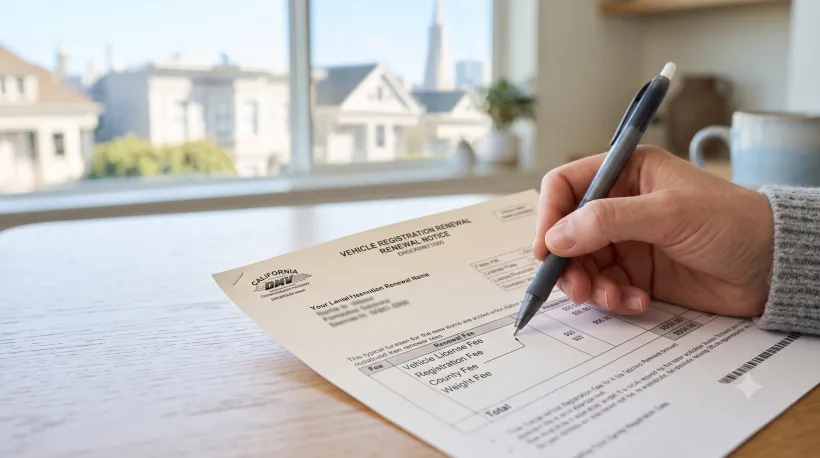
El sistema de registración de California no es una tarifa fija: es una fórmula que acumula un cargo base de registración, un impuesto a la propiedad vehicular, un recargo para el financiamiento de carreteras, una contribución para la patrulla de caminos y lo que sea que su condado agregue encima.
El total se ve diferente para cada conductor porque está construido con componentes que cambian según el valor de su vehículo, edad, tipo e incluso el lugar de California donde viva.
Desglosamos cada componente, explicamos cuáles aplican a qué vehículos y le damos cifras estimadas realistas para las categorías de vehículos más comunes. Una advertencia honesta por adelantado: varias de las tarifas de California se ajustan periódicamente y pueden variar según factores como la fecha de la transacción, el nivel de valor del vehículo y el condado. La única fuente para conocer su total exacto es la calculadora de tarifas oficial del DMV de California. Úsela para obtener su número específico.

Los componentes que integran cada factura de registración
Antes de hacer el desglose por tipo de vehículo, ayuda entender los elementos básicos. Cada factura de registración de California se arma a partir de un conjunto de categorías de tarifas, y saber qué es —y qué no es— cada una hace que el total sea mucho menos misterioso.
Tarifa base de registración
La tarifa base de registración y la tarifa del CHP son montos fijos que no cambian según su vehículo. La tarifa base de registración es de $76, y la tarifa de la Patrulla de Caminos de California (CHP) es de $34; este es el monto actual en 2026. Estos dos cargos son los mismos para prácticamente cualquier vehículo registrado para circular en carreteras en California, sin importar si maneja un sedán de diez años o un SUV nuevecito. Estos fondos financian las operaciones del DMV y la aplicación de la ley por parte del CHP en todo el estado.
Tarifa de licencia del vehículo (VLF)
La tarifa de licencia del vehículo (VLF) es el 0.65% del precio de compra de su vehículo o del valor evaluado actual. Los ingresos van a las ciudades y condados, y el DMV lo trata como un impuesto a la propiedad personal que usted puede deducir en su declaración federal.
La VLF es usualmente el cargo individual más grande en su factura para los vehículos más nuevos, y disminuye a medida que su carro envejece. Cada año después de la compra, el DMV aplica un cronograma de depreciación que reduce el valor gravable: el año dos usa el 90% del precio de compra, el año tres usa el 80%, y va bajando aproximadamente 10 puntos porcentuales al año hasta llegar al 15% del precio original en el año 11. Después del año 11, la VLF se mantiene en ese piso a menos que el vehículo cambie de manos, lo que reinicia el cálculo al nuevo precio de venta.
Solo la parte de la VLF de su factura de registración es deducible como impuesto a la propiedad personal en su declaración federal de impuestos sobre la renta si detalla sus deducciones. La tarifa base de registración, la tarifa del CHP, la TIF y las tarifas del condado no son deducibles. El DMV ofrece una herramienta de búsqueda dedicada de "VLF para fines fiscales" en dmv.ca.gov exactamente por esta razón.
Ciertos grupos están exentos de la VLF por completo. Los siguientes grupos no tienen que pagar una tarifa de licencia de vehículo: veteranos discapacitados con una calificación de discapacidad del 100% relacionada con el servicio; personal militar no residente establecido en California y sus cónyuges no residentes; tribus nativas americanas de California y miembros de tribus; tribus nativas americanas reconocidas federalmente; y vehículos de transporte especializado.
Tarifa de mejora del transporte (TIF)
La TIF fue creada por el Proyecto de Ley del Senado 1 en 2017 y se ajusta a la inflación cada año. Financia reparaciones de carreteras, mantenimiento de puentes e infraestructura de transporte en todo el estado. A diferencia de la VLF, que es un porcentaje directo, la TIF se divide en niveles según el valor del vehículo.
La TIF se aplica a las registraciones originales, transferencias y renovaciones para la mayoría de los vehículos de pasajeros. Los vehículos comerciales con un peso sin carga de 10,001 libras o más están exentos de pagar la TIF.
Debido a que la TIF se ajusta a la inflación anualmente, los límites exactos de los niveles y los montos cambian de año en año. Fuentes externas reportan un rango de aproximadamente $28 a $224 según el valor del vehículo, pero estas cifras deben tratarse solo como estimaciones. (Verifique los niveles de la TIF del año en curso para el valor específico de su vehículo usando la calculadora de tarifas del DMV).
Tarifa de la Patrulla de Caminos de California (CHP)
La tarifa de la Patrulla de Caminos de California es de $34 y se cobra para la mayoría de los vehículos registrados para uso en carreteras. Esta es una tarifa fija que financia las operaciones del CHP en todo el estado. Aparece en cada factura de registración estándar, sin importar el tipo o valor del vehículo.
Tarifas del condado y del distrito
Aquí es donde los costos de registración se diferencian más de un conductor de California a otro. Además de las tarifas estatales, cada condado agrega sus propios cargos: tarifas de gestión de la calidad del aire, tarifas de SAFE (Autoridad de Servicio para Emergencias en Autopistas), tarifas de transporte local y varias evaluaciones específicas del distrito.
Los condados de Los Ángeles, Alameda (Área de la Bahía) y San Diego tienen las tarifas de distrito más altas —típicamente en el rango de $40 a $50— que cubren programas como la gestión de la calidad del aire, la eliminación de vehículos abandonados y recargos para la automatización de las cortes. Los condados rurales a menudo se acercan más al mínimo de $25.
Las tarifas de calidad del aire las establece cada distrito de gestión de la calidad del aire y van de $2 a $19. Las tarifas de SAFE van de $1 a $3. Estos son los cargos en su aviso de renovación que a menudo generan más preguntas, porque son pequeños individualmente, pero se acumulan y varían sin explicación.
Tarifas por tipo de vehículo
Los componentes anteriores se aplican en diferentes combinaciones dependiendo de lo que esté registrando. Así es como se acumulan para las categorías de vehículos más comunes.
Vehículos de pasajeros estándar (Gasolina e Híbridos)
El escenario de registración más común. Se aplican todos los componentes: tarifa base, VLF al 0.65% del valor depreciado, TIF adaptada al valor del vehículo, tarifa del CHP y los cargos adicionales del condado.
La mayoría de los conductores de California pagan entre $300 y $450 al año por un carro de pasajeros mediano estándar, aunque el monto exacto depende en gran medida del valor del vehículo y del condado. Los vehículos más nuevos o más caros pueden superar los $600 al año una vez que la VLF y la TIF se aplican por completo.
Una tarifa adicional se aplica a los vehículos de gasolina que son más nuevos de ocho años de modelo: los vehículos de gasolina de menos de ocho años de modelo pagan una tarifa anual de reducción de smog de $20 en lugar de necesitar una inspección de smog bienal durante esos primeros años. Una vez que el vehículo supera el límite de los ocho años de modelo, la tarifa de reducción desaparece y el vehículo queda sujeto a las inspecciones de smog regulares.
Cómo se ve una factura típica para un sedán mediano de $30,000, en su tercer año de registración:
- Tarifa base de registración: $74
- VLF (0.65% × $30,000 × 80% de depreciación): ~$156
- TIF (basada en un valor depreciado de ~$24,000): (revise la calculadora para el nivel actual)
- Tarifa del CHP: $29
- Tarifas del condado: $25–$50 dependiendo de la ubicación
- Tarifa de reducción de smog (si tiene menos de 8 años de modelo): $20
- Total estimado: $300–$450+ dependiendo del condado y del nivel de la TIF
Vehículos eléctricos y vehículos de cero emisiones
Los vehículos eléctricos tienen un perfil de tarifas notablemente diferente al de los carros de gasolina. Por un lado, están exentos de las inspecciones de smog y de la tarifa de reducción de smog —sin prueba bienal, sin cargo anual de reducción de $20—. Por el otro lado, conllevan una tarifa específica de mejora de carreteras que los carros de gasolina no pagan.
Debido a que los vehículos eléctricos no pagan los impuestos a la gasolina que financian el mantenimiento de las carreteras, California cobra una Tarifa de Mejora de Carreteras (RIF) en todos los vehículos de cero emisiones (ZEV) del año de modelo 2020 y posteriores.
Verifique el monto actual de la RIF para su vehículo específico y año de modelo usando la calculadora de tarifas del DMV; puede cambiar entre ciclos de registración.
La RIF no se cobra en la registración inicial de un ZEV recién comprado a un concesionario de vehículos autorizado —solo en las renovaciones posteriores—. Así que si acaba de comprar un EV nuevo de un concesionario de California, la registración del primer año no incluirá la RIF. Esta entra en vigor en la renovación.
La VLF, la TIF, la tarifa base, la tarifa del CHP y las tarifas del condado se aplican a los EV de la misma manera que a los vehículos de gasolina.
¿Cómo se ve una factura típica para un EV de $45,000, en su segundo año de registración (primera renovación)?
- Tarifa base de registración: $74
- VLF (0.65% × $45,000 × 90% de depreciación): ~$263
- TIF (basada en un valor depreciado de ~$40,500): (revise la calculadora para el nivel actual)
- Tarifa del CHP: $29
- Tarifas del condado: $25–$50
- Tarifa de mejora de carreteras (RIF): ~$100–$121
- Sin tarifa de reducción de smog
- Total estimado: $550–$650+, dependiendo del condado y del nivel de la TIF
Vehículos históricos y de colección (Horseless Carriage)
Los vehículos a los que el DMV les asigna placas de vehículo histórico o horseless carriage califican para una estructura de tarifas significativamente reducida. Los vehículos de valor o interés histórico a los que se les emiten placas de horseless carriage o vehículo histórico están sujetos a una VLF anual de $2.
Esta VLF de $2, combinada con la tarifa base de registración y las tarifas de placas aplicables, hace que la registración de vehículos históricos sea una de las categorías menos costosas en el sistema de California. Estos vehículos también están generalmente exentos de las inspecciones de smog. Las tarifas reducidas reflejan la naturaleza de uso limitado de los vehículos históricos, que no se manejan típicamente como transporte diario.
Vehículos comerciales
Los vehículos comerciales ligeros —pickups y camiones usados comercialmente dengan un peso sin carga inferior a 10,001 libras— pagan la tarifa base estándar, la VLF y la tarifa del CHP, más las tarifas de peso calculadas según el peso sin carga del vehículo y el número de ejes.
Las tarifas de peso para esta categoría varían significativamente según el vehículo. La tasa de la VLF para vehículos comerciales es del 0.65% del valor de mercado, la misma que para los vehículos de pasajeros. La TIF se aplica a estos vehículos a menos que superen el límite de 10,001 libras.
Los vehículos comerciales pesados —aquellos operados de forma independiente o en combinación con un peso bruto vehicular declarado de 10,001 libras o más— caen bajo la estructura de tarifas de la Ley de Registración de Vehículos Comerciales (CVRA), que es sustancialmente diferente al cronograma de vehículos de pasajeros.
Además de las tarifas de la CVRA, la tarifa de registración y la tarifa de licencia del vehículo, estos vehículos están sujetos a lo siguiente: la tarifa de vehículos motorizados de la CVRA de $122; la tarifa del Programa de Interdicción de Robo de Carga de $3, y la tarifa de la CVRA del CHP de $36.
Las tarifas de peso de la CVRA se basan en el peso bruto vehicular declarado y se calculan a partir de las tablas de tarifas del DMV que varían según la clase de peso. Estos vehículos también están exentos de la TIF. Para los operadores de flotas y propietarios-operadores de vehículos comerciales pesados, la estructura de tarifas es lo suficientemente compleja como para que usar la calculadora de tarifas del DMV con el GVW específico declarado del vehículo sea la forma más confiable de estimar los costos.
Tarifas que se aplican según la situación —no en cada renovación
Más allá de los componentes anuales, varias tarifas se aplican solo en circunstancias específicas. Vale la pena conocerlas porque a menudo aparecen de forma inesperada.
- Tarifa de título: Aplica cuando se emite o reemplaza un título —no en las renovaciones estándar.
- Tarifa de transferencia: Se cobra cuando la propiedad de un vehículo cambia de manos. Aplica tanto a las ventas entre particulares como a las transacciones de concesionarios.
- Tarifa de reducción de smog ($20): Tarifa anual para vehículos de gasolina de menos de ocho años de modelo, en lugar de una inspección de smog bienal.
- Tarifa de operación no planificada (PNO): En lugar de las tarifas de registración completas, el propietario de un vehículo que certifique que este no será operado ni guardado en vías públicas paga una tarifa de PNO reducida.
- Penalizaciones por demora: No es técnicamente una categoría de tarifa, sino un multiplicador de costos significativo. Las penalizaciones se calculan como un porcentaje de la VLF más tarifas fijas de registración y cargos por demora del CHP, evaluadas en un cronograma de niveles según el tiempo de retraso del pago.
- Tarifas de placas especiales: Las placas especiales, personalizadas y de organizaciones conllevan tarifas adicionales más allá de los costos de las placas estándar.
Lo que la calculadora de tarifas del DMV le dirá y lo que no
La calculadora de tarifas oficial del DMV es la herramienta más precisa para estimar lo que debe. Toma en cuenta el valor depreciado específico de su vehículo, las tarifas adicionales de su condado y el cronograma de tarifas del año en curso —incluyendo cualquier ajuste por inflación a la TIF.
Lo que calcula bien: renovaciones estándar de vehículos de pasajeros, estimaciones de registración de vehículos nuevos, estimaciones de tarifas de compra de vehículos usados y la VLF para fines fiscales.
Lo que señala como fuera de su alcance: renovaciones de operación no planificada, registración de año parcial, autobuses escolares privados y registración de flota permanente. Para estos casos, el DMV recomienda llamar al 1-800-777-0133 entre las 8 a.m. y las 5 p.m., de lunes a viernes.
Una nota importante del propio DMV: las tarifas varían según la transacción real de registración de su vehículo. Por ejemplo, si el precio de compra ingresado por el cliente difiere de lo que finalmente se anota en el título y se envía al DMV, las tarifas de registración del vehículo pueden cambiar cuando este se registre. La calculadora le da una estimación sólida, pero su factura real se determina cuando el DMV procesa la transacción.

FAQ
- ¿Cuánto cuesta registrar un carro en California?
La mayoría de los conductores de California pagan entre $300 y $450 al año por un carro de pasajeros mediano estándar, aunque el monto exacto depende en gran medida del valor del vehículo y del condado. Los vehículos más nuevos o más caros pueden superar los $600 al año. La única fuente oficial para su total específico es la calculadora de tarifas del DMV en dmv.ca.gov, que toma en cuenta el valor depreciado de su vehículo, las tarifas de su condado y el cronograma de tarifas del año en curso.
- ¿Qué es la Tarifa de Licencia del Vehículo (VLF) y cómo se calcula?
La VLF es la versión de California de un impuesto a la propiedad personal sobre los vehículos. Se calcula al 0.65% del valor evaluado depreciado de su vehículo. El DMV aplica un cronograma de depreciación que reduce el valor gravable aproximadamente un 10% al año durante los primeros diez años, después de lo cual el valor se estabiliza en el 15% del precio de compra original hasta que el vehículo sea transferido. La VLF es el único componente de su factura de registración que es deducible en su declaración federal de impuestos sobre la renta como impuesto a la propiedad personal.
- ¿Qué es la tarifa de mejora del transporte (TIF) y quién la paga?
La TIF fue creada por el Proyecto de Ley del Senado 1 en 2017 para financiar las reparaciones de carreteras porque los ingresos por impuestos a la gasolina eran insuficientes. Es una tarifa escalonada basada en el valor evaluado actual de su vehículo, que se aplica a las registraciones originales, transferencias y renovaciones para la mayoría de los vehículos de pasajeros. Los vehículos comerciales con un peso sin carga de 10,001 libras o más están exentos de pagar la TIF. Debido a que se ajusta за inflación anualmente, los montos exactos de los niveles cambian año con año —use la calculadora de tarifas del DMV para las cifras actuales.
- ¿Los vehículos eléctricos pagan las mismas tarifas que los vehículos de gasolina en California?
Los EV pagan la mayoría de las mismas tarifas —registración base, VLF, TIF, tarifa del CHP y tarifas del condado—, pero su perfil de tarifas difiere en dos aspectos. Están exentos de las inspecciones de smog y de la tarifa anual de reducción de smog de $20. A cambio, los vehículos de cero emisiones del año de modelo 2020 y más nuevos deben pagar una Tarifa de Mejora de Carreteras (RIF) anual al renovar, lo que compensa los ingresos por impuestos a la gasolina que estos vehículos no generan. La RIF no se cobra en la registración inicial de un EV nuevo comprado a un concesionario de California—solo en las renovaciones posteriores.
- ¿Por qué mi registración cuesta más que la de mi vecino para un carro similar?
Los cargos adicionales del condado y del distrito son el punto donde las facturas de registración de California difieren más de un condado a otro. Si está en el condado de Los Ángeles, Alameda o San Diego, sus tarifas locales son más altas que en la mayoría de los condados rurales. Más allá de eso, las diferencias en el precio de compra del vehículo, el año del modelo y cuántos ciclos de renovación han pasado afectan los componentes de la VLF y la TIF de manera independiente.
- ¿Es deducible de impuestos alguna parte de mi tarifa de registración?
Sí —únicamente la VLF—. La tarifa base de registración, la tarifa del CHP, la TIF y las tarifas del condado no son deducibles porque no se calculan como un porcentaje del valor de su vehículo. El IRS exige que una tarifa sea un impuesto ad valorem (basado en el valor) para calificar como una deducción de impuestos a la propiedad personal. El DMV ofrece una herramienta de búsqueda dedicada de "VLF para fines fiscales" para los conductores que necesitan el monto deducible exacto.
- ¿Cuánto pagan los vehículos comerciales para registrarse en California?
Depende en gran medida del vehículo. Los vehículos comerciales ligeros de menos de 10,001 libras de GVW pagan la tarifa base estándar, la VLF al 0.65% y tarifas de peso basadas en el peso sin carga y los ejes. Los vehículos comerciales pesados de más de 10,001 libras de GVW caen bajo la estructura de tarifas de la CVRA, que incluye una tarifa de vehículos motorizados de la CVRA de $122, una tarifa del Programa de Interdicción de Robo de Carga de $3 y una tarifa de la CVRA del CHP de $36, más tarifas de peso basadas en el peso bruto vehicular declarado. Estos vehículos están exentos de la TIF. Use la calculadora de tarifas del DMV para el GVW declarado de su vehículo específico, o llame al DMV al 1-800-777-0133 para estimaciones de tarifas de vehículos comerciales complejos.
- ¿Por qué mi tarifa de registración es diferente este año de la del año pasado —para el mismo carro?
Varias cosas cambian año con año, incluso para el mismo vehículo. La VLF disminuye a medida que baja el valor evaluado depreciado del carro. La TIF se ajusta a la inflación anualmente, por lo que los límites de los niveles y los montos cambian. Las tarifas del condado y del distrito pueden aumentar de forma independiente. Si su condado agregó un recargo o aumentó uno existente, su total puede subir incluso si la VLF baja.
- ¿Qué tarifas se aplican al comprar un carro usado en California?
Al comprar un vehículo usado, usted pagará las tarifas de registración estándar más una tarifa de transferencia de título y, en la mayoría de los casos, el impuesto de uso de California (el equivalente al impuesto sobre las ventas, aplicado al precio de compra). La calculadora de tarifas del DMV tiene una herramienta específica para compras de vehículos usados que estima todas las tarifas aplicables en función del precio de venta y los detalles del vehículo. Tenga en cuenta que California no reduce el monto gravable por el valor de un vehículo entregado en intercambio (trade-in): el impuesto de uso se aplica al precio de compra total, independientemente de cualquier intercambio.
- ¿Puede Xtreet ayudarme a descifrar lo que debo antes de renovar?
Xtreet procesa renovaciones de registración como socio autorizado con licencia del DMV de California, y la plataforma recupera los detalles de su renovación directamente de la base de datos del DMV —incluyendo el total de su tarifa actual— cuando termina de enviar el formulario. Esto le da el monto real adeudado según lo calculado por el DMV para su vehículo y condado específicos, no una estimación.
Conclusión
Las tarifas de registración de California parecen complicadas porque lo son —por diseño—. Cada componente financia algo específico: la tarifa base y la tarifa del CHP cubren las operaciones del DMV y de la patrulla de caminos; la VLF reemplaza lo que otros estados cobran como impuesto a la propiedad; la TIF financia reparaciones de infraestructura que los impuestos a la gasolina por sí solos no pueden cubrir; y las tarifas del condado financian programas locales que varían según el distrito.
Una vez que sabe qué es cada cargo, la factura deja de parecer un misterio y comienza a verse como lo que es: una fórmula aplicada a su vehículo específico.
La conclusión práctica: si quiere saber lo que debe antes de que llegue su aviso de renovación, la calculadora de tarifas del DMV es la herramienta más precisa disponible, y es gratis.
Si quiere completar la renovación en sí sin visitar una oficina del DMV, Xtreet maneja el pago y el procesamiento en línea como socio autorizado del DMV, enviándole su esticker por correo.