Why California Vehicle Registration Can Cost $700 or More: A Complete 2026 Breakdown
Quick Answer: Registration in California is not a fixed amount. It consists of several separate fees, and while registration for an older car might cost $200, the total for a new or expensive car can easily exceed $700. The three main variables are the car’s value, the county of registration, and the type of vehicle.
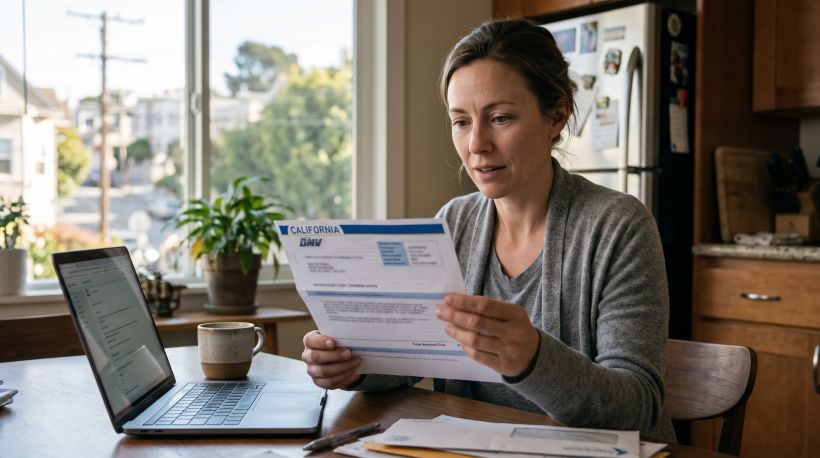
If you opened your California registration renewal notice and felt a moment of genuine confusion about the total, you are in good company.
Most drivers see the final number, assume something went wrong, and spend ten minutes on the DMV website before giving up. The number is not a mistake. California's registration bill is built from several separate charges, and two of them scale directly with the value of your car. For a newer or more expensive vehicle, those two charges alone can push the total past $500 before a single county fee is added. Add a high-fee county like Los Angeles or the Bay Area, and $700 is a realistic outcome for a first-year registration on anything approaching a luxury vehicle.
The structure behind the number is actually straightforward once you see it.
There are fixed charges that are identical for every registered vehicle in California, value-based charges that grow and shrink with your car's assessed worth, and local charges that vary entirely by where the car is registered. This guide breaks down all three, shows what each component looks like in three real-world examples, and explains how to check your own total before paying.
The Four Charges That Make Up Every California Registration Bill
Most drivers treat the renewal notice as a single payment. It is not. California law builds every passenger vehicle renewal from four main components, each serving a different purpose and calculated differently. Understanding which part of the bill comes from where is the fastest way to understand why yours is the number it is.
The base registration fee and the California Highway Patrol fee are the only two amounts that are the same for every driver in the state. The base registration fee is currently $76, which includes a $3 Alternative Fuel and Technology Fee. The CHP fee is $34. Together they add $110 to every standard registration bill, regardless of what you drive or where you live. These fees fund DMV operations and statewide highway patrol enforcement.
Everything else on your bill is a variable.
The vehicle license fee is calculated at 0.65% of your vehicle's current assessed value. This is California's version of a personal property tax on vehicles, and it is the component that makes the largest difference between a bill for an older car and a bill for a new one.
For a vehicle assessed at $7,000, the VLF is $45. For a vehicle assessed at $35,000, it is $228. For a vehicle assessed at $60,000, it reaches $390.
The VLF decreases each year as the assessed value depreciates on a schedule set by the DMV, which is why longtime owners of the same vehicle notice their registration getting cheaper annually. It is also the only component that qualifies as a deductible personal property tax on your federal income tax return, if you itemize deductions.
The Transportation Improvement Fee was created by Senate Bill 1 in 2017 to fund road repairs and bridge maintenance. Unlike the VLF, which is a continuous percentage, the TIF works in tiers based on your vehicle's current market value. The current 2026 tiers are:
Vehicle value | TIF |
| $0 to $4,999 | $33 |
| $5,000 to $24,999 | $66 |
| $25,000 to $34,999 | $132 |
| $35,000 to $59,999 | $198 |
| $60,000 and above | $231 |
The TIF is inflation-adjusted annually, so the tier amounts shift slightly each year. Commercial vehicles with an unladen weight of 10,001 pounds or more are exempt from paying the TIF. Standard passenger vehicles are not.
Where You Live Changes the Bill
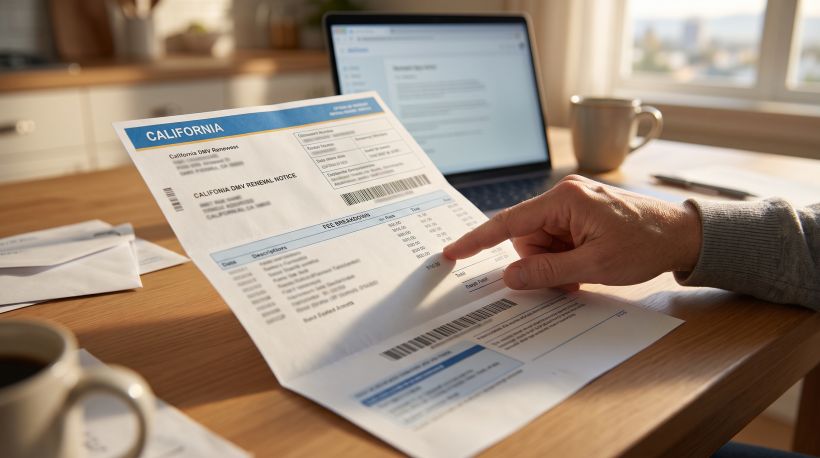
The four components above are set by California state law and apply statewide. What sits on top of them is set locally, by agencies that operate independently of the California DMV. These county and district fees vary more than most drivers realize, and they are entirely outside the driver's control.
County and district fees typically fund a combination of programs: air quality management, Service Authority for Freeway Emergencies (SAFE), abandoned vehicle abatement, auto theft prevention, and in some counties, voter-approved local transportation measures. None of these are optional line items. They are embedded in your renewal total automatically based on your registered address.
The variation between counties is significant. Drivers in Los Angeles, Alameda, and San Diego counties face the highest local add-ons in the state. Drivers in rural counties often pay closer to the minimum.
| Area | Approximate local fees |
| Los Angeles County | $25 to $45 |
| San Francisco and Bay Area | $19 to $29 |
| San Diego County | $20 to $35 |
| Rural counties | $5 to $15 |
The Air Quality Management District fee is collected on top of general county fees and varies by district.
The San Joaquin Valley Air Pollution Control District charges up to $19, which is why drivers in Fresno and Bakersfield often find their bills higher than expected compared to similarly valued vehicles registered elsewhere. The South Coast AQMD, which covers the Los Angeles basin, adds $6 to $7.
The DMV fee calculator incorporates county-specific fees when you enter your vehicle details. No published statewide list covers every county, which is why the calculator is more accurate than any general estimate for your specific address.
Extra Fees That Apply Only in Specific Situations
Beyond the four standard components and the county add-ons, several fees appear only under specific circumstances. These are the ones most likely to generate genuine surprise on a renewal notice, because they show up without obvious explanation.
The smog abatement fee is $20 per year and applies to gasoline-powered vehicles that are fewer than eight model years old.
These vehicles are exempt from California's biennial smog inspection during those early years, but they pay an annual fee in its place. Once the vehicle ages past eight model years, the abatement fee disappears from the bill, and the biennial inspection requirement begins. The fee is not large individually, but it appears on the bill of nearly every newer vehicle and is rarely explained on the notice itself.
Separately, when a vehicle that does require a biennial smog check passes the inspection, a state-mandated certificate fee of $8.25 is collected at the testing station.
This goes to the state, not to the station, and it is added to the station's bill only on a passing test. It does not appear on the DMV renewal notice because it is collected before the renewal is submitted.
The Road Improvement Fee applies to zero-emission vehicles of model year 2020 and newer at renewal. Because electric vehicles do not pay gasoline taxes that fund road maintenance, California introduced this fee to compensate for that lost revenue. The current 2026 figure is reported across multiple sources as approximately $121 per year.
It does not apply to the initial registration of a new EV purchased from a licensed California dealer, only to renewals. For EV owners who bought their vehicle before this fee existed, the first renewal where it appears can be genuinely startling.
Late penalties are not a fee category in the standard sense, but they are the most common reason a renewal total looks dramatically higher than expected. California has no grace period.
Penalties begin accruing the day after the registration expires, on a tiered schedule applied to the VLF:
- 1 to 10 days late: 10% of VLF, plus a $10 registration late fee and a $10 CHP late fee
- 11 to 30 days: 20% of VLF, plus $15 and $15
- 31 days to one year: 60% of VLF, plus $30 and $30
- more than one year to two years: 80% of VLF, plus $50 and $50
- more than two years: 160% of VLF, plus $100 and $100.
On a vehicle with a $300 VLF, missing renewal by more than two years adds $480 in VLF penalties alone, before flat fees.
Three Real-World Examples: Around $200, $400, and $700+
The fee structure makes more sense with specific numbers.
The following three examples use current 2026 fee amounts. They are illustrative: your exact total depends on the DMV's assessed value for your specific vehicle, your county's current fees, and any other charges on your vehicle record. For your exact amount, use the DMV fee calculator or request a free estimate through Xtreet.com before paying.
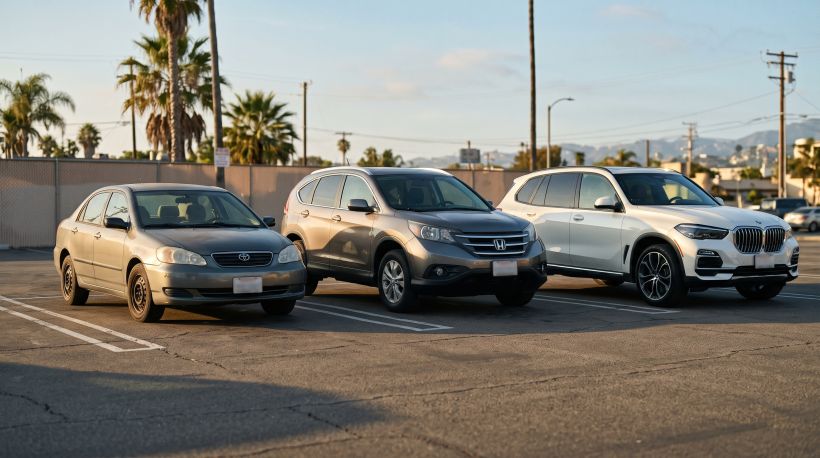
Around $200: A 10-year-old Honda Civic in a rural county
A vehicle originally purchased for $22,000, now in its tenth year and assessed by the DMV at approximately $7,000, registered in a rural California county:
| Component | Amount |
| Base registration fee | $76 |
| CHP fee | $34 |
| VLF (0.65% of $7,000) | $45 |
| TIF ($5,000 to $24,999 tier) | $66 |
| County fees (rural) | ~$10 |
| Estimated total | ~$231 |
The vehicle is old enough that its assessed value has dropped significantly, and the low-fee county keeps the local add-ons minimal. No smog abatement fee applies because the vehicle is past eight model years, though a smog inspection is required.
Around $400: A 5-year-old Toyota Camry in San Diego
A mid-size sedan in its fifth year, assessed at approximately $22,000, registered in San Diego:
| Component | Amount |
| Base registration fee | $76 |
| CHP fee | $34 |
| VLF (0.65% of $22,000) | $143 |
| TIF ($5,000 to $24,999 tier) | $66 |
| Smog abatement fee | $20 |
| County fees (San Diego) | ~$35 |
| Estimated total | ~$374 |
The vehicle is in the middle of its depreciation curve. The VLF is meaningful but not at its peak. The smog abatement fee applies because the vehicle is under eight model years old.
$700+: First-year registration of a new BMW X5 at $65,000 in Los Angeles
A new luxury SUV, purchase price $65,000, first registration in Los Angeles County:
| Component | Amount |
| Base registration fee | $76 |
| CHP fee | $34 |
| VLF (0.65% of $65,000) | $422 |
| TIF ($60,000 and above tier) | $231 |
| Smog abatement fee | $20 |
| LA County and air district fees | ~$40 |
| Estimated total | ~$823 |
This is why first-year registration on an expensive vehicle is a genuine budget item. The VLF and TIF together account for $653 of the total before a single county fee is added, because both scale directly with purchase price and the highest TIF tier applies.
Why New and Expensive Cars Cost So Much More to Register
The third example makes the pattern clear, but it is worth stating directly: the reason registration is expensive for newer or more valuable vehicles is that two of the four main components, the VLF and the TIF, are anchored to purchase price.
When you buy a $60,000 car, you are starting the VLF calculation from a high base and landing in the top TIF tier. Both of those numbers are locked in until the vehicle depreciates into a lower bracket.
The VLF depreciation works in your favor over time. California reduces the assessed value annually for eleven years, roughly 10 percentage points per year until it reaches a floor of 15% of the original purchase price. For a $65,000 vehicle, the VLF trajectory looks like this:
- Year 1: 0.65% of $65,000 = $422.
- Year 3 (80% of purchase price): 0.65% of $52,000 = $338.
- Year 6 (50%): 0.65% of $32,500 = $211.
- Year 11 (15% floor): 0.65% of $9,750 = $63.
That is a reduction of more than $350 on the VLF alone over the vehicle's first eleven years, without any action required from the owner. It is why longtime owners of the same vehicle notice their registration getting meaningfully cheaper each year, and why the first two or three years after buying a new car are consistently the most expensive.
There is one important reset rule: when a vehicle changes ownership, the depreciation clock resets to year one using the new sale price.
A ten-year-old car that the previous owner was registering cheaply can generate a significantly higher bill for the new buyer because the VLF is now calculated from the purchase price rather than from the previous owner's depreciated value.
How Xtreet.com Helps Before You Pay
Knowing how the fee structure works is useful. Knowing your exact total before you pay is more useful.
When you enter your plate number and VIN on Xtreet's platform as a licensed California DMV partner, the system retrieves your renewal details directly from the DMV database and shows you an itemized breakdown before you confirm anything: state fees, county fees, any outstanding holds, and your total.
The service fee for registration renewal is $49.95, separate from all state and county charges, and a 20% discount applies for customers experiencing financial hardship. The complete fee breakdown is available at this page before any transaction begins.
The DMV's own fee calculator is also a reliable starting point. Either way, knowing the number in advance removes the moment of surprise that sends most drivers to Google wondering if the DMV made a mistake.

Frequently Asked Questions
Why does California charge more for vehicle registration than most other states?
California's higher registration costs reflect a combination of factors: one of the largest registered vehicle fleets in the country (over 35 million vehicles), an extensive road network that requires significant maintenance funding, and a Vehicle License Fee that functions as a personal property tax on vehicles rather than a flat fee. Most states charge flat registration fees that don't scale with vehicle value. California's VLF and TIF both scale with value, which is why a new $65,000 vehicle costs several times more to register than a ten-year-old car worth $7,000.
What is the Vehicle License Fee and why does it change every year?
The VLF is 0.65% of your vehicle's DMV-assessed value, which decreases annually on a depreciation schedule over eleven years. It functions as a personal property tax on the vehicle and is the only component of your registration bill deductible on your federal income tax return if you itemize. Once a vehicle changes ownership, the assessed value resets to the new purchase price, and the depreciation cycle begins again.
Why is my first-year registration so much more expensive than renewal?
Because the VLF is calculated from the full purchase price in year one, and for a new vehicle, that is typically the highest it will ever be. Additionally, the TIF tier is assigned based on full purchase price. Both components decrease in subsequent years as the assessed value depreciates. Registration reliably gets cheaper each year you own the same vehicle until the VLF floor is reached at year eleven.
Does where I live in California affect my registration cost?
Yes, significantly. County and district fees vary from approximately $5 in rural counties to $45 or more in Los Angeles County. Air Quality Management District fees add another $2 to $19 depending on your air district. These fees are set locally and are outside the California DMV's control. Two identical vehicles registered in different counties will generate different renewal totals.
Do electric vehicles pay more or less to register in California?
Neither consistently. EVs are exempt from smog inspections and the $20 annual smog abatement fee, which reduces their bill compared to equivalent gasoline vehicles. However, model year 2020 and newer zero-emission vehicles are subject to a Road Improvement Fee at renewal, currently approximately $121, which compensates for gasoline tax revenue EVs don't generate. The VLF, TIF, base registration, CHP fee, and county fees all apply to EVs the same as to gasoline vehicles.
What happens if I miss the renewal deadline in California?
Penalties begin accruing the day after the registration expires, with no grace period. The penalty is calculated as a percentage of the VLF, plus flat registration and CHP late fees, on a tiered schedule. Missing renewal by more than one year adds 80% of your VLF in penalties plus $100 in flat fees. Missing by more than two years adds 160% of your VLF plus $100.
Can any part of my registration fee be deducted from my taxes?
Only the VLF. Because the VLF is an ad valorem tax calculated as a percentage of your vehicle's value, it qualifies as a deductible personal property tax on your federal return if you itemize deductions. The base registration fee, CHP fee, TIF, and county fees do not qualify. The DMV provides a VLF for Tax Purposes lookup for the exact deductible amount.
How do I find out my exact renewal amount before paying?
Use the DMV's registration renewal fee calculator, which incorporates your vehicle's specific assessed value and your county's current fees. Alternatively, enter your vehicle information on Xtreet's platform for a free estimate pulled directly from the DMV database.
Conclusion
California's registration fee is expensive not because the DMV charges arbitrarily, but because the bill is assembled from multiple components that each serve a distinct purpose, and two of them, the VLF and the TIF, grow with vehicle value. A ten-year-old car assessed at $7,000 registered in a rural county can come in around $230. A new luxury vehicle at $65,000 in Los Angeles can exceed $800. Both results are correct. Both follow the same formula.
The number on your renewal notice makes sense once you know the components behind it. The VLF decreases every year you own the same vehicle. The TIF tier drops as the assessed value falls. County fees vary by address and are outside anyone's control. And for most drivers, the fastest path to avoiding an unexpected total is to check the number before the renewal notice arrives, rather than after.
Xtreet.com retrieves your itemized fee breakdown from the DMV database before you pay a dollar, handles any holds that might be blocking the renewal, and refunds any overage between estimate and final invoice.
Get a free estimate before your next renewal.