Moved to California? You Have 20 Days to Register Your Car
Quick Answer: California gives you 20 days to apply for registration of an out-of-state vehicle, counted from the date registration fees became due. A typical packet includes Form REG 343, your out-of-state title and registration, a VIN verification on Form REG 31, a California smog certification for most vehicles, proof of insurance, and payment.
If you miss the window, DMV penalties apply and grow in steps, so a late application is still cheaper than a later one.
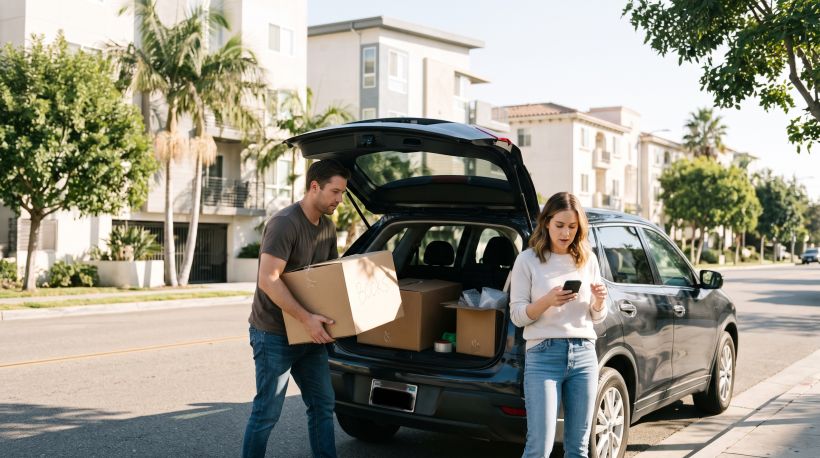
Moving takes more time than anyone plans for. You relocated, and for the first few days you were still remembering about your car registration. And then the new jobs, schools, the boxes, and the lease signing took over. On day 21, you realized the DMV deadline slipped by.
The steps below show how you can get registered with the smallest penalty possible.
This guide covers four things:
- how the 20 days are counted and why the rule exists;
- the documents, VIN verification, and smog check you need;
- what a late application costs;
- how to limit the damage if the 20 days have already passed.
What the 20-Day Rule Says, and Why It Exists
The rule comes from California Vehicle Code Section 4152.5. When a car last registered in another state needs California registration, the application must reach the DMV within 20 days after the date registration became due, and the DMV treats it as an original application.
The start date is where people get tripped up. The 20 days do not begin when you cross the state line. The day on which the registration countdown starts is usually the day you establish residency or take a job in California or the day your old registration expires, whichever comes first. The deadline applies to the application and the fees, so submit on time.
Residency is also broader than a move-in date. The DMV treats you as a resident if you spend six months or more of a 12-month period in California, or if California is where you work, vote, lease a home, or send your children to school, or where your current driver license was issued.
For most newcomers, day one is the day you start a California job or sign a California lease. If your old registration expires earlier, count from that date instead. When in doubt, count from the earliest date.
The rule exists for three reasons:
- A vehicle that is based in California or driven here more than in any other single state must be registered here under Vehicle Code Section 4000.4
- An out-of-state registration lets you drive in California only until you establish residency
- California registration confirms that the car meets state emission rules, and the DMV cannot register a vehicle that does not qualify
Your registration fees then fund DMV operations, the California Highway Patrol, and road maintenance.
What You Need to Register an Out-of-State Car
There is a checklist for nonresident vehicles. Every item below comes from it, and every item matters, because a missing signature or an unauthorized verifier is the most common reason an application bounces back. The checklist lists the following requirements.
Item | What to know |
| REG 343, Application for Title or Registration | Signed by every registered owner shown on the out-of-state title or registration. For a leased car, the lessor signs. |
| Last out-of-state title | If it is not surrendered, California marks the registration card “Nontransferable” and does not issue a California title. |
| Last out-of-state registration | The registration card, a current renewal notice, or a letter, fax, or wire from the last state confirming owner names and expiration date. |
| REG 31, Verification of Vehicle Identification Number | Completed by an authorized DMV employee, a law enforcement officer, or a California-licensed vehicle verifier. |
| California smog certification | Required for most gasoline and diesel vehicles. |
| Out-of-state plates | You normally surrender them. Exceptions: plates that are expired, plates that must go back to the issuing state, and interstate registered vehicles. |
| Fees | Registration, transfer, and use tax fees. The DMV can calculate the exact amount only when it receives your application. |
Two items on this list need extra attention: VIN verification and the title.
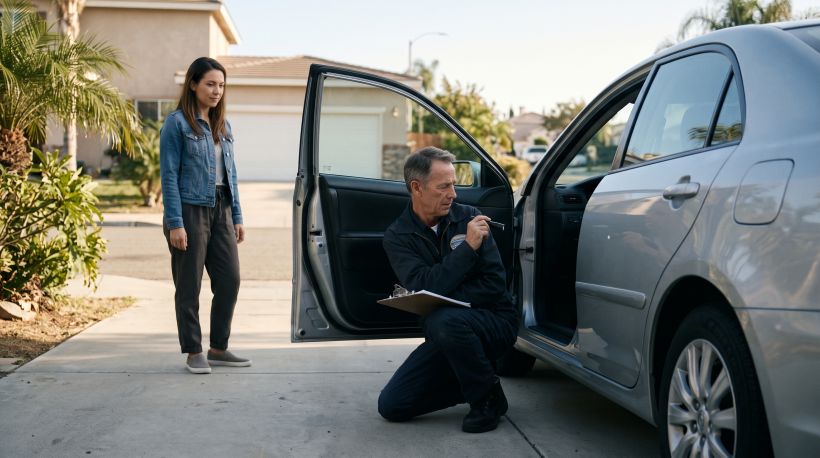
VIN verification is a physical check that the VIN on your paperwork matches the VIN on the car. An authorized DMV employee, a law enforcement officer, or a California-licensed vehicle verifier can complete the REG 31.
Download the current version of the form from the DMV website or ask Xtreet.com support team, because the DMV updated it in September 2025, and older versions may be refused.
The DMV also lists exceptions to VIN verification for certain vehicles like new trailers and new commercial vehicles that meet certain requirements. So check VIRP, chapter 12.165, to see whether yours qualifies before you book anything.
The title is the other item that can slow you down. If you still owe money on the car, your lender usually holds the title. Ask the lender early to release or send it, because the process varies by state and by lender, and some states issue electronic titles that must be converted first.
You also need California liability insurance. For policies purchased or renewed on or after January 1, 2025, the state minimums are $30,000 for injury to one person, $60,000 for injury to more than one person, and $15,000 for property damage (Senate Bill 1107).
Smog Check for an Out-of-State Car
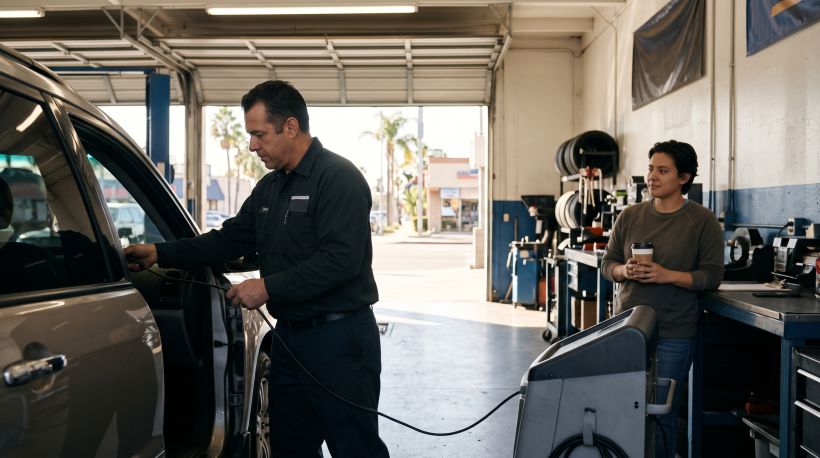
Most importantly, California does not accept an out-of-state smog test, no matter how recent it is. The certification must come from a California smog station.
It is required for gasoline vehicles of model year 1976 and newer (motorcycles are exempt), for diesel vehicles of model year 1998 and newer under 14,001 pounds GVWR, and for natural gas or propane vehicles under 14,001 pounds GVWR.
Electric vehicles, gasoline vehicles of 1975 and older, and diesel vehicles of 1997 and older or over 14,000 pounds GVWR are exempt.
Timing works in your favor. When your car passes, the station stores an electronic certificate at the DMV, and that certificate stays valid for 90 days. A test taken in your first week in California is usually still good on day 20 and often on day 40. You do not have to send paper to the DMV, and you cannot get away with a wrong date, because the date comes from the station’s electronic record.
Step-by-Step: Registering Your Car Within 20 Days
The sequence below keeps you inside the window and puts the slow items first.
Step 1: Fix your day one
Write down the earlier of two dates: the day you established residency or the day your out-of-state registration expires. Add 20 days and put the result on your calendar.
Step 2: Check whether your car needs a smog certification
Use the categories above. If it does, book a California smog station in your first week. The certificate will be in the DMV system, valid for 90 days, while you figure out other stuff.
Step 3: Get the VIN verification
Check for an exemption first.
If you need the inspection, choose a DMV office, a law enforcement officer, or a California-licensed vehicle verifier. A DMV office can handle VIN verification without an appointment if that is the only service you need (confirm this on the DMV website for your office).
If the car is still in another state, a peace officer there can complete it on the California REG 31.
Step 4: Collect your documents
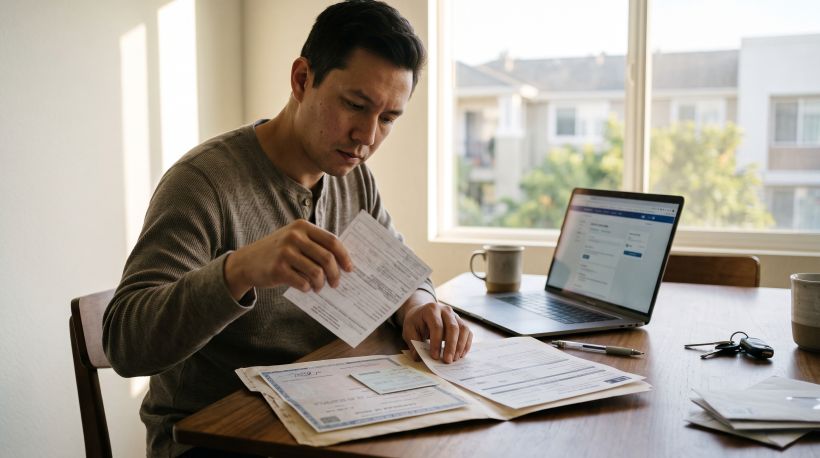
You need a REG 343 signed by every owner, your title (or your lender’s release), your last out-of-state registration, your completed REG 31, and proof of California insurance.
Call your lender now if one holds the title.
Step 5: Submit the application and pay the fees by day 20
You can apply through the DMV or through a DMV-authorized provider such as Xtreet.com. If one document is still missing, submit anyway, because the application date is what protects you from penalties.
Step 6: Keep proof and wait for your plates and registration card
Keep your confirmation and your insurance card in the car until the new registration arrives.
What Happens If You Miss the 20 Days
The consequence is a penalty on top of the fees you already owe.
The DMV charges penalties when fees are not paid within 20 days of the date they became due. The standard late-registration schedule applies a percentage of the vehicle license fee (and the weight fee, where one applies), plus flat registration and CHP late fees.
| How late | Penalty on VLF | Registration late fee | CHP late fee |
| 1 to 10 days | 10% | $10 | $10 |
| 11 to 30 days | 20% | $15 | $15 |
| 31 days to 1 year | 60% | $30 | $30 |
| More than 1 year to 2 years | 80% | $50 | $50 |
| More than 2 years | 160% | $100 | $100 |
The DMV counts penalty days with its Table of Penalty Dates. The exact number of late days in your case is calculated by the DMV when it processes the application.
Here is what that looks like in dollars. If a vehicle’s vehicle license fee is $200, the first tier adds 40 (20 plus $10 plus $10), the 11 to 30 day tier adds $70, and the 31 day to one year tier adds $180. These are illustrations, not DMV quotes. Your amount depends on your vehicle’s value and weight.
Penalties are not the only risk.
After you become a resident, your old registration no longer covers driving in California. Driving a vehicle that needs California registration without it is an infraction under Vehicle Code Section 4000(a), with a base fine of $280 and a realistic total of $300 to $500 after court assessments.
Already Late? How to Keep the Cost Down
If day 20 has passed, your goal changes. You cannot undo the penalty window, but you can stop it from reaching the next tier. Every step in the schedule above costs more than the one before it, so speed matters more than perfection.
- Submit the renewal application and fees now
Do not wait for the missing documents. The DMV accepts an application that lacks a title or smog certification, and the application date is what stops the clock from moving to the next tier.
Note: this does not apply to original registration or title transfer.
- Check the date on your smog certificate
If your test is 21 days old, it is still valid. The certificate lasts 90 days. You do not need a new test, and you do not need to rush to a second station.
Do not change dates, signatures, or documents. Some people in this situation hear advice to adjust a date “because the DMV will not know.” The DMV will know. The smog result comes from the station’s electronic record, and your application is a signed statement. False information on a DMV application can create problems far larger than a late fee.
- Do not count on a waiver
The DMV can waive registration penalties only in specific cases written into Vehicle Code Section 9562, such as a stolen vehicle that was recovered or a qualifying military deployment. A hectic move is not on that list, so plan to pay the penalty and focus on keeping it small.
- Do not count on the grace period
California has no grace period for registration renewal.
- Ask for your exact total before you pay
The DMV fee calculator and the itemized breakdown on a DMV-authorized provider both show you what you owe before you commit.
Common Mistakes
- Waiting for every document before applying
The application date protects you from penalties, so submit first and finish the rest as the DMV requests.
- Assuming the old registration still covers you
After residency starts, driving on the out-of-state registration is no longer covered.
- Taking the smog test in your old state
California accepts only a certification from a California smog station.
- Using an unauthorized person or an old form for VIN verification
Only a DMV employee, a law enforcement officer, or a California-licensed vehicle verifier can complete the REG 31, and it must be the current version.
- Skipping a co-owner’s signature
The REG 343 needs the signature of every owner shown on the out-of-state title or registration.
- Forgetting the lender
A financed car has its title with the lender, and that delay is the one you cannot fix on day 19.
How Xtreet.com Helps
Xtreet LLC is a DMV-authorized third-party provider.
For an out-of-state vehicle, you can complete the transfer and registration through Xtreet.com without a personal visit to a DMV office, as long as your documents are collected first.
The process runs in four steps:
- Check whether your vehicle qualifies for an exception to VIN verification.
- If it does not, complete the physical check through the DMV or another permitted verifier, such as a California-licensed vehicle verifier or another authorized party. Xtreet.com is not one of them.
- Submit the application in less than 2 minutes.
A direct DMV visit becomes necessary only if your situation requires it: a problematic title, a vehicle missing from the DMV system, a VIN mismatch, a salvage record, a nonstandard vehicle status, or a request from the DMV.
Xtreet.com’s service fee, DMV fees, and shipping are separate charges, and you can review the itemized breakdown before you pay.
Xtreet.com cannot remove DMV penalties and cannot replace the VIN verification. What it removes is the DMV trip for the submission and the guesswork about which documents belong in the packet. After your first California registration is issued, annual renewals also run through Xtreet.com.

Frequently Asked Questions
When do the 20 days start?
They start on the date registration fees become due. For a car that is still registered in another state with the same owner, that is the earlier of the day you establish California residency and the day your out-of-state registration expires. Starting a California job, signing a lease, or registering to vote can all establish residency.
Does the smog test have to be done within 20 days?
No. The 20 days apply to the application and the fees. The smog certification is valid for 90 days from the test date, so a test taken early in your move is usually still good when you submit. If your test is older than 90 days, you need a new one.
What if I only have a few days left and I am missing documents?
Submit the application and pay the fees anyway. The DMV advises applying on time even when the title or smog certification is not ready, because the application date is what protects you from penalties.
How much will I pay if I am late?
You owe the normal registration fees plus a penalty. The penalty is a percentage of the vehicle license fee plus flat registration and CHP late fees, and it rises from 10% in the first tier to 160% after two years. On a $200 vehicle license fee, the first tier adds $40. The DMV fee calculator shows your full total.
Can the DMV waive my penalty because I just moved?
The DMV can waive penalties only in specific situations listed in Vehicle Code Section 9562, such as a recovered stolen vehicle or a qualifying military deployment. A busy move is not one of them, so plan to pay the penalty and act quickly to keep it small.
Do I have to visit the DMV in person?
The VIN verification needs a physical inspection by an authorized person: a DMV employee, a law enforcement officer, or a California-licensed vehicle verifier. The submission itself can go through a DMV-authorized provider such as Xtreet.com without your personal visit once the packet is complete. A DMV visit is needed only if your case requires it, for example, a problematic title or a VIN mismatch.
Do I keep my old license plates?
Normally you surrender them to the DMV. You can keep them if they are expired, if they must be returned to the issuing state, or if the vehicle is interstate registered.
Does this apply to active-duty military?
Often not. Active-duty service members who are nonresidents, and their nonresident spouses, may renew their vehicle registration in their home state instead of California. The rules depend on your status, so check the DMV’s nonresident military guidance.
Can the DMV refuse to register my car?
Yes, if the vehicle does not meet California emission requirements. The DMV also warns that California residents generally cannot bring in or register a car under two years old with fewer than 7,500 miles at purchase unless it was built to California emission standards or an exemption applies. Check this before you buy a car out of state.
Conclusion
The 20-day rule is short, but it is simple once you know what it counts.
The clock starts when fees become due, usually at residency, and it measures when you apply and pay, not when every document is ready. A smog certificate from your first week is still good weeks later; a REG 31 can be done by several authorized parties, and a late application costs less than a later one.
If you are inside the 20 days, move the slow items first: smog, VIN verification, and your lender’s title. If you are past day 20, submit the application and fees now, keep your real dates, and let the DMV calculate the penalty.
Both paths end the same way, with a California registration you do not have to think about for another year.
Xtreet.com handles the submission online as a DMV-authorized provider, with an itemized breakdown before you pay and no personal DMV visit for the transfer when your documents are ready. Start your out-of-state registration on Xtreet.com today, and let the next 20 days be the last time this deadline worries you.