What Happens If Your Car Is Not Registered for Years in California
A car sits in the garage while life gets complicated. Maybe it needed a repair you kept putting off. Maybe you moved and stopped driving it. Maybe the registration lapsed during a hard year and the problem kept growing until it felt too big to deal with. Whatever the reason, a vehicle that hasn't been registered in California for years isn't just an administrative inconvenience—it accumulates real financial consequences, can disappear from the DMV's digital records entirely, and requires a more involved process to bring back to legal status than a standard renewal.
The good news is that none of this is permanent. California has clear procedures for every stage of registration lapse—from one missed year to a vehicle that's been sitting untouched for a decade. The path forward depends on how long the registration has lapsed, whether the vehicle was on public roads during that time, and what documentation you still have. This guide walks through each stage honestly: what you owe, what happens to the record, how to bring the vehicle back, and where Xtreet can make that process easier.
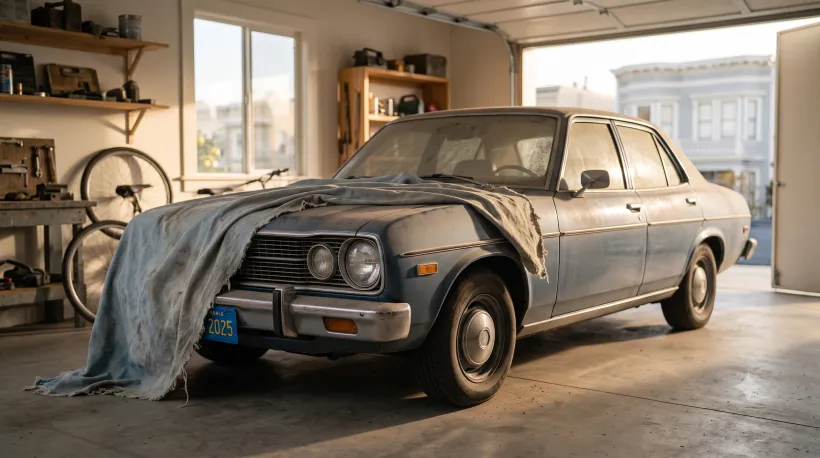
The First Year of Lapse—Penalties Accrue Immediately
The California DMV does not offer a grace period for paying annual vehicle registration fees. The day after your registration expires, penalties begin. Most drivers imagine there's some buffer—a week, maybe a month—before consequences kick in. There isn't.
Penalties are determined by adding a percentage of the vehicle license fee, plus a registration late fee, plus a California Highway Patrol (CHP) late fee. The structure is tiered and compounds as time passes:
| How late | % of VLF + weight fee | Registration late fee | CHP late fee |
| 1–10 days | 10% | $10 | $10 |
| 11–30 days | 20% | $15 | $15 |
| 31 days–1 year | 60% | $30 | $30 |
| More than 1 year–2 years | 80% | $50 | $50 |
| More than 2 years | 160% | $100 | $100 |
These penalties stack per delinquent year—not as a single total. A vehicle lapsed for three years is carrying penalty calculations for each of those years separately, added together. On a vehicle with a $400 base fee and $300 VLF, missing more than two years means $300 × 160% = $480 in VLF penalties alone, plus $200 in flat fees, per delinquent year. The numbers move fast.
The only legitimate exceptions to penalty assessment are narrow and specific. The DMV may waive penalties for late renewal for any period during which the registered owner was deployed to a location outside California—subject to specific documentation requirements. Fees and penalties may also be waived for any registration year when a transferee applies for transfer and it is determined that the registration fees became due prior to the transferee's date of purchase. Outside of these specific situations, penalties apply without exception.
The Vehicle Is Off the Road—PNO as a Partial Solution
If your car genuinely wasn't driven, towed, or parked on any public California road during a registration year, you may have had the option to file for Planned Non-Operation status instead of paying full registration fees. If the motor vehicle is not used during an entire calendar year, you must submit a Certificate of Non-Operation (REG 102) and pay a PNO status filing fee on or before December 31 of that year to avoid penalties.
The window matters. You may still apply for PNO status within 90 days after December 31, but penalties will be due. After 90 days, eligibility for PNO status is forfeited, and full-year fees and penalties are due.
A Planned Non-Operation may be filed up to 90 days after the registration expiration date if the vehicle was not operated in any manner, but applicable late penalties are due.
For vehicles that have been sitting for multiple years without any PNO filings, the practical reality is that the 90-day windows for each past year have closed. Full fees and penalties apply to every lapsed year—PNO can only reduce costs going forward on a vehicle that genuinely remains off public roads, not retroactively for years already elapsed.
One critical rule: after you apply for PNO, if you decide to operate your vehicle or park it somewhere where it could get a parking ticket, then you need to pay full vehicle registration fees and penalties for that year. PNO is not a legal shelter for a vehicle that's occasionally moved or parked on a public street.
Four or More Years—The DMV Record Disappears
This is the stage most drivers don't anticipate, and it changes the re-registration process significantly. Digital records for your vehicle may no longer be available if your titled vehicle has not been registered in California for four years or longer.
It's hard to pinpoint the exact date when this happens, so check your car's status after the fourth year to see what stage you're at.
A vehicle that drops out of the DMV's digital database isn't gone from California's system forever—but it can't be renewed through the standard online portal, and it can't be looked up by plate number or VIN the way a current vehicle can. To bring it back, you're not completing a renewal. You're re-establishing a record from scratch, which requires a different set of documents and, in most cases, an in-person visit to a DMV office.
The documentation required to re-establish a vehicle record when it has dropped out of the DMV's system includes: a completed Application for Title or Registration (REG 343); a Verification of Vehicle (REG 31), which must be completed by an authorized DMV employee or a peace officer—not self-certified; the original California Certificate of Title or an expired registration card; and a Certificate of Non-Operation (REG 102) or Statement of Facts (REG 256) certifying the vehicle's non-operation during the lapsed period. The Odometer Disclosure Statement (REG 262) is also required for vehicles less than ten model years old—this form is printed on security paper and must be requested by phone at 1-800-777-0133, as it's not available for download.
If you don't have the original title—only a photocopy, or nothing at all—the process adds further steps: an Application for Replacement or Transfer of Title (REG 227) and a detailed Statement of Facts (REG 256) explaining how and when you acquired the vehicle, what efforts were made to contact the previous owner, and why standard proof of ownership isn't available.
The VIN verification step is the one that requires the most planning. The REG 31 must be completed by an authorized person—a DMV employee at a field office VIN verification lane, a peace officer, or a licensed mobile verifier. DMV field offices handle VIN verifications without an appointment in a dedicated lane, but the rest of the document submission may require one.
What Happens If You Drive an Unregistered Vehicle
Operating an unregistered vehicle in California is a violation of California Vehicle Code § 4000(a), regardless of how long the registration has been lapsed or why. There is no provision that excuses driving an unregistered vehicle because the owner intends to fix it soon.
Under AB 245, operative from July 1, 2024, through January 1, 2030, expired registration alone cannot be the sole basis for a traffic stop until the second month after the month of expiration. This is not a grace period—DMV penalties accrue from day one, and if an officer stops a vehicle for any other reason, the expired registration can be cited immediately regardless of how recently it lapsed.
A citation under VC § 4000(a) carries a base fine of $280, with court penalty assessments bringing the realistic total to $300–$500 depending on the county. Most first citations for expired registration are issued as correctable violations—if you complete the registration within the court's deadline and provide proof, the citation is typically dismissed for a nominal processing fee of around $25. Repeat citations for the same unresolved issue are less likely to receive that treatment.
For vehicles that have been unregistered for multiple years, law enforcement also has discretion to impound. Recovering an impounded vehicle in California typically requires proof of current registration before the car is released—meaning you're solving the registration problem under time pressure while paying $200–$400 in towing fees and $50–$100 per day in storage.
When a Fee or Penalty Waiver Is Possible
Most drivers in this situation assume there's no path around the penalties. In specific circumstances, there is—though the bar is high.
The DMV may waive the renewal fees and penalties when a stolen or embezzled vehicle is subsequently recovered by the owner and the vehicle was not operated between the date the registration expired and the theft or embezzlement date. The current renewal fees become due upon return of the stolen or embezzled vehicle to the owner's possession, and those fees or a PNO must be filed within 20 days of that date. A Miscellaneous Certifications (REG 256A) form must be submitted with the application.
Penalties only shall be waived for late renewal for any period during which the registered owner was deployed to a location outside California, subject to specific documentation requirements including proof of temporary military duty during a period specified by Presidential Executive Order and an application submitted within 60 days after termination of deployment.
Outside of these specific circumstances—stolen vehicle recovery and qualifying military deployment—penalties are not waived through an appeal process. The REG 256 penalty waiver request covered in earlier guides on DMV notices applies to administrative failures by the DMV, not to extended non-registration.

How to Get Back to Legal Status: The Practical Sequence
Regardless of how many years the vehicle has been unregistered, the path back to legal status follows a consistent sequence. The steps don't change—only the complexity and cost at each stage.
Step 1: Check whether a DMV record still exists
Go to the DMV site and search by plate number and last five VIN characters. If nothing comes back, the digital record may have been purged—four or more years without registration is the typical threshold.
Call 1-800-777-0133 to confirm, and ask what the DMV shows on file for your VIN.
Step 2: Get your exact fee total
Use the DMV fee calculator with your vehicle's details. The calculator applies the correct penalty tier for each delinquent year and gives you the most accurate estimate of what you owe before you submit anything.
Step 3: Address outstanding holds
Outstanding parking tickets or toll violations block renewal across all channels. These need to be resolved before the registration transaction can complete.
Step 4: Sort out smog
If your vehicle is subject to California's biennial smog check requirement—gasoline vehicles more than eight model years old—you'll need a passing smog certificate before registration can be completed. A vehicle that's been sitting for years may have issues that cause it to fail; testing at a test-and-repair station rather than a test-only station is worth considering.
Step 5: Gather documents and complete the re-registration
For vehicles still in the DMV's digital system, this can often be done online or through a licensed partner. For vehicles that have dropped out of the system after four or more years, this requires the full document set described above and, at minimum, a VIN verification in person.
Step 6: Clear any existing citations
If the vehicle has already been cited for expired registration, present proof of renewed registration to the court within the deadline on the citation.
How Xtreet Can Help
Getting a long-lapsed vehicle back to legal status involves multiple moving parts, and this is where Xtreet's services as a licensed California DMV partner are useful.
For vehicles still in the DMV's system, Xtreet handles online registration renewal directly—retrieving your current fee total from the DMV database, surfacing any outstanding violations or holds on the account, and processing payment for multiple delinquent years in a single session. Your new registration card and sticker are mailed to you after processing.
For vehicles that need a title transfer as part of getting back to legal status—for example, if the vehicle changed hands informally during the lapsed period and ownership was never formally transferred—Xtreet's title transfer service handles that process online without requiring a DMV office visit.
For replacement registration cards and stickers—which may be needed if the original documents from the last valid registration year are no longer available—Xtreet handles those requests through the platform as well.
Where Xtreet cannot substitute for the DMV directly: the VIN verification required for vehicles that have dropped out of the digital record must be completed in person by an authorized person—a DMV employee, peace officer, or licensed mobile verifier.
Xtreet's support team can help you understand what's required for your specific situation and where to go for the steps that need to happen in person, but the physical VIN inspection itself is outside what any online platform can complete on your behalf.

FAQ
- What happens if I don't register my car for years in California?
Penalties accrue from the day after registration expires, with no grace period. The penalty structure is tiered—from 10% of the Vehicle License Fee for the first ten days up to 160% for registrations lapsed more than two years—and applies separately to each delinquent year. After four or more years without registration, the vehicle's digital record may be purged from the DMV's system entirely, requiring a more involved re-registration process rather than a standard renewal. Driving the vehicle at any point during the lapsed period is a violation of California Vehicle Code § 4000(a).
- How much will I owe for years of unpaid registration in California?
It depends on your vehicle's specific fees and how many years are delinquent. The penalty for each year lapsed more than two years is 160% of the Vehicle License Fee plus a $100 registration late fee plus a $100 CHP late fee, on top of the base registration fees for that year. These are calculated per year and stacked. The DMV fee calculator gives the most accurate estimate for your specific vehicle.
- Can the DMV still find my vehicle if it hasn't been registered in years?
Possibly not. Digital records for titled California vehicles may no longer be available if the vehicle has not been registered for four years or longer. If a search by plate number or VIN returns nothing, call 1-800-777-0133 to check. If the record has been purged, re-registration requires a formal application with VIN verification and supporting documentation—not a standard online renewal.
- Can I file a Planned Non-Operation for past years to reduce what I owe?
Only within 90 days of each year's registration expiration date. After that window closes, PNO cannot be applied retroactively to that year—full fees and penalties are due. For vehicles that have been sitting for multiple years with no PNO filings, the windows for past years have almost certainly closed. PNO can reduce costs going forward for a vehicle that will remain off public roads.
- Is there any way to get the penalties waived?
In limited circumstances: if the vehicle was stolen or embezzled and not operated between the lapsed registration date and the theft date, penalties and fees for that period may be waived upon recovery. If the registered owner was deployed outside California during the lapsed period under qualifying military orders, penalties—but not fees—may be waived with appropriate documentation submitted within 60 days of the end of deployment. Outside these specific situations, penalties are not waived.
- Do I need to go to the DMV in person to re-register a vehicle that's been unregistered for years?
It depends on how long the vehicle has been unregistered. If the DMV's digital record still exists and the vehicle has all other requirements met—smog current, no outstanding holds—online renewal through dmv.ca.gov or through Xtreet is possible. If the record has been purged after four or more years, re-registration requires a physical VIN verification (REG 31) by an authorized person, which means at minimum a visit to a DMV field office VIN verification lane or an appointment with a licensed mobile verifier.
- What if I want to sell the car instead of re-registering it?
You can sell a vehicle with a lapsed registration—the buyer takes on the responsibility of registering it. However, you must complete a Notice of Transfer and Release of Liability to protect yourself from liability after the sale. If the title has not been in your name—or if it's lost—a title transfer or replacement title process will need to be completed as part of the sale. Xtreet handles title transfers online for private-party sales.
- Can Xtreet help me re-register a car that hasn't been registered in years?
For vehicles still in the DMV's digital system, yes—Xtreet can process the renewal online, retrieve your fee total including penalties for delinquent years, clear outstanding parking or toll violations in the same session, and handle replacement registration documents.
For vehicles that require VIN verification because they've dropped out of the DMV's system, that physical inspection step must be completed in person. Xtreet's support team can help orient you toward the right process for your specific situation.
- What if the car was never registered in California at all?
If the vehicle was purchased from outside California or was brought in from another state and never registered here, the process is an original registration rather than a renewal—requiring an application, California smog inspection, VIN verification, use tax payment, and applicable fees. This is distinct from a lapsed renewal situation and follows the out-of-state registration process.
Conclusion
A vehicle that hasn't been registered in California for years is a fixable problem—but the longer it goes unaddressed, the more expensive and complicated the fix becomes. Penalties compound on a set schedule. After four years, the digital record disappears. After enough time on public roads without registration, citations and impoundment risk make the situation actively costly rather than just administratively overdue.
The practical starting point is always the same: find out exactly where the vehicle stands—whether the DMV record still exists, what the total owed is, and whether there are any additional holds or requirements to address before the registration can go through. From there, the path is clear even if it's not short.
Xtreet handles the parts of that path that can be done online: registration renewals with delinquent years included, outstanding violation clearance, title transfers for ownership that needs to be formally established, and replacement registration documents.
For steps that require in-person interaction—VIN verification in particular—Xtreet's support team can help you understand what's needed and where to go. The goal is to get back to legal status efficiently, without more trips and paperwork than the situation actually requires.