Renew Your California Registration Without Overpaying: All Legal Options Compared
California gives you more ways to renew your vehicle registration than most drivers realize. The DMV office is the option everyone knows—and the one most people dread. But it's also the least necessary, because for the majority of standard renewals, you never have to walk through those doors at all. Online renewal through the DMV's own portal, mail-in renewal, self-service kiosks, and DMV-authorized business partners all handle the same transaction, with different tradeoffs in convenience, speed, and cost.
What none of them can do is reduce the underlying registration fees themselves. California law prohibits discounted vehicle registration renewals—the DMV issued an explicit public warning in June 2025 about fraudulent advertisements claiming to offer exactly that. The fees the DMV calculates for your vehicle are the fees you pay, regardless of which channel you use to submit them. What does vary between channels is how much extra you pay on top, how quickly it gets done, and how much friction is involved when your situation isn't completely straightforward. This guide covers every legal option honestly, so you can choose the one that actually fits your situation.

Option 1: Online Through the California DMV—The Baseline
The DMV's own online renewal portal is the starting point for any cost comparison because it carries no service fee beyond the state-mandated registration charges themselves. What you pay online through the DMV is exactly what the DMV calculated for your vehicle—no markup, no processing surcharge, no convenience fee. If you manage to fill out the registration form, that's not a bad option.
Online renewal is available to most California drivers as long as the vehicle's record is clear: no outstanding parking or toll violations, no insurance flag, no smog certification pending, and no other holds that would prevent the transaction from completing. If your record is clean and your smog is current, renewal takes about five minutes. Payment is accepted by credit card, debit card, or electronic check. Your new registration card and sticker arrive by mail within approximately two weeks.
The DMV's online system requires your license plate number and the last five characters of your VIN. If you have your renewal notice handy, the renewal identification number on it speeds things up—but it isn't required.
One limitation worth knowing: the online portal doesn't handle every situation. Partial-year renewals, planned non-operation filings, and certain specialty transactions aren't available through the standard online renewal flow. For those, you'll need a different channel.
Option 2: By Mail—The Set-It-and-Forget-It Option
Mail renewal has been around longer than the internet and still works reliably for drivers who prefer not to transact online or who don't have a renewal notice with a QR code. It carries no service fee—you pay exactly the state-mandated fees, the same as online.
The process: write your license plate number on your check or money order made payable to the California DMV, include your current mailing address if it has changed, and send it to the payment processing address on your renewal notice or listed at dmv.ca.gov. If you're paying through your bank's online bill pay system, your license plate number must appear on the check—this is a DMV requirement, not a bank one.
The tradeoff is time. Mail renewal is the slowest option by a significant margin. Processing time for a mailed check runs several weeks, and the sticker and registration card are mailed back after processing—not immediately. Budget at least six to eight weeks from the date you mail your payment to the date you'd expect the sticker to arrive. If your registration is close to its expiration date, mail renewal is a risky choice.
One important caution from the DMV: do not place a stop payment on a mailed check while waiting to see if it was received—the DMV may still be processing it, and a stopped check is treated as a dishonored payment with a $30 administrative fee added. If eight weeks have passed and the check hasn't cleared your bank, call 1-800-777-0133 to investigate.
Mail renewal also doesn't work for situations with outstanding holds. If there are parking violations or other flags on the account, a mailed payment will be processed, but the registration won't be complete until those are resolved—and you won't find out until after the check has cleared.
Option 3: DMV Self-Service Kiosks—In-Person Speed Without the Line
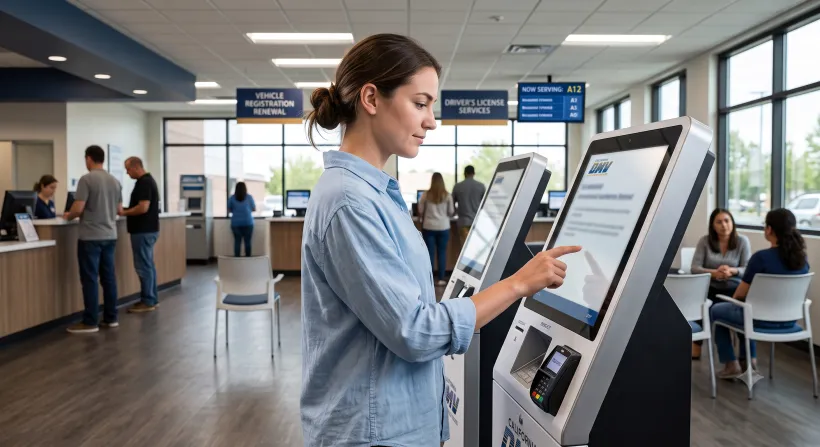
California DMV offices have self-service terminal (SST) kiosks available at select field offices and some retail locations. These are touchscreen machines that handle registration renewals, driver's license transactions, and other services without requiring you to wait in line for a DMV employee.
Kiosks are faster than the standard DMV counter experience for straightforward renewals—they process the transaction immediately and can issue a temporary receipt on the spot while the permanent sticker is mailed. No appointment is needed.
The kiosk option works well when you want the immediacy of an in-person transaction without the wait time of the full counter experience. It handles standard renewals for vehicles with clean records. Like the DMV's own online portal, kiosks don't carry a service fee beyond the state registration charges.
Kiosks are not available at every DMV location, and hours track with the office's operating hours rather than being 24/7. The DMV's website lists kiosk locations.
Option 4: In Person at a DMV Field Office—When Nothing Else Will Do
The full DMV counter experience is the option most people default to out of habit—and the one that's actually the least necessary for standard renewals. That said, there are situations where it's genuinely the right call.
In-person service at a DMV field office is necessary or strongly recommended when your situation involves a VIN correction requiring physical verification, a name change requiring secondary photo ID, a vehicle that needs to be re-established in the system after years of inactivity, or any other transaction that requires a staff member to review documents in person. For those cases, an appointment booked through the DMV site is strongly recommended—walk-in wait times at busy California DMV offices can run several hours.
For a standard registration renewal with no complications, there's no procedural advantage to going in person versus renewing online. The fees are identical, the processing is the same, and the sticker still arrives by mail afterward. The only thing you gain is the ability to pay cash—which the online portal and mail options don't accept—and the immediate confirmation from a staff member that everything is in order.
DMV field offices are open Monday through Friday, with some offices open on Saturdays. Hours vary by location and are listed at dmv.ca.gov.
Option 5: DMV-Authorized Business Partners—When Convenience Is Worth a Service Fee
California's Business Partner Automation (BPA) program authorizes private businesses to process certain DMV transactions—including registration renewals, title transfers, and replacement documents—directly through a connection to the DMV's own database.
Business partners are authorized to process and issue validated registration cards, full-year registration stickers, and automobile and commercial license plates and many other services but may charge an additional fee for this.
The state fees you pay through a BPA partner are exactly the same as through the DMV directly—BPA partners submit the exact fees calculated by the DMV. What differs is the service fee the partner charges on top. As of January 1, 2026, a $2 fee increase applies to all DMV transactions submitted electronically through a licensed BPA partner. Individual partners may charge additional service fees beyond this.
That's the honest tradeoff: BPA partners cost a little more than the DMV's own channels. What they offer in return is a different kind of value—one that matters most when the renewal isn't completely straightforward.
What BPA partners handle that the DMV portal doesn't always resolve smoothly?
The DMV's online portal works well, but it is slow and hard to figure out.
This is where licensed DMV partners like Xtreet add value that goes beyond just processing the payment. Xtreet's platform retrieves your complete renewal details from the DMV database when you enter your plate number and VIN, and if you have all the necessary documents with you, you can complete the registration form or sign up for another service in less than two minutes (yes, we timed it because your convenience is our priority).
For drivers whose renewal situation is anything other than completely clean—or who've simply had enough of navigating multiple government portals—that combination of services in one place is worth the little service fee.
One thing worth flagging explicitly: California law prohibits the DMV from offering discounted vehicle registration renewals. If you see an advertisement for discounted DMV fees, do not reach out to the advertiser—the DMV issued this warning in June 2025 in response to fraudulent social media ads. Any service promising to reduce your underlying state registration fees is a scam. Legitimate BPA partners like Xtreet charge the same state fees as the DMV itself plus a transparent service fee with their own personal discounts specifically on their own services—nothing more, nothing less.
How the Options Compare at a Glance
We've put together a short checklist for you to make your choice easier.
| Channel | State fees | Additional cost | Processing speed | Best for |
| DMV online (dmv.ca.gov) | Standard | None | 1–2 days to process; sticker ~2 weeks by mail | Clean renewals, lowest total cost |
| Mail to DMV | Standard | None | 6–8 weeks total | Drivers who prefer not to transact online and have plenty of time |
| DMV self-service kiosk | Standard | None | Immediate; sticker by mail | In-person convenience without a line |
| DMV field office | Standard | None | A long wait for your turn; immediate confirmation; sticker by mail | Complex situations, corrections, cash payments |
| BPA partner (e.g., Xtreet) | Standard | Service fee + $2 BPA e-file fee from Jan 2026 | Fast; sticker by mail | Holds clear, multiple services in one session; convenience |
The One Thing That Actually Reduces Your Registration Cost
Since no channel offers a discount on state fees, the only legitimate ways to reduce what you owe are built into the registration formula itself—not into the payment channel you choose.
The vehicle license fee decreases automatically every year as your vehicle's assessed value depreciates. You don't have to do anything to get this reduction—it happens on a set schedule. On a vehicle originally purchased for $35,000, the VLF alone drops by roughly $190 over eleven years.
Planned Non-Operation (PNO) is available if your vehicle genuinely won't be on public roads for an entire registration year. Filing PNO costs significantly less than full registration fees, and it's the only legal mechanism to reduce what you owe on a vehicle you're not driving. It must be filed before the vehicle is operated—it can't be applied retroactively beyond a 90-day window after expiration.
Smog exemptions eliminate both the biennial inspection cost and the annual $20 smog abatement fee for electric vehicles and pre-1976 gasoline vehicles. If you're considering a vehicle purchase, the smog fee picture is part of the ongoing registration cost calculation worth factoring in.
That's the complete list of legitimate cost-reduction levers. Everything else—the channel, the timing, the partner—affects convenience and speed, not the underlying fees.
FAQ
- What is the cheapest way to renew my California vehicle registration?
The lowest-cost channels are the DMV's own online portal, mail renewal, and DMV self-service kiosks—all of which charge only the state-mandated registration fees with no additional service fee. Licensed DMV business partners add a service fee on top of the same state fees. No channel legally reduces the underlying registration fees themselves—California law prohibits discounted registration renewals.
- Can I renew my California registration without going to the DMV?
Yes—in most cases, entirely. Online renewal through the DMV's own online portal, mail renewal, and licensed DMV business partners like Xtreet all handle standard renewals without requiring a DMV office visit. In-person visits are necessary only for situations requiring physical document review or VIN verification.
- How long does online registration renewal take in California?
The transaction itself takes about two to five minutes. It depends on the service you choose. The DMV processes the payment within one to two business days. Your new registration card and sticker arrive by mail within approximately two weeks of processing. If you're close to your expiration date, online is significantly faster than mail renewal.
- What's the difference between renewing through the DMV and through a licensed partner?
The state fees are identical—BPA partners submit the exact fees calculated by the DMV. The difference is the service fee the partner charges on top and the additional services available.
- Is it safe to renew my registration through a third-party website?
Only if the company is a licensed California DMV Business Partner Automation (BPA) participant. Licensed BPA partners connect directly to the DMV's database and submit the exact fees calculated by the DMV. Xtreet is a licensed California DMV partner. Be cautious of any site that claims to offer discounted registration fees—the DMV issued a public fraud warning in June 2025 about scam advertisements making exactly that claim.
- Can I pay cash for my registration renewal in California?
Cash is accepted at DMV field offices and some self-service kiosk locations. It's not accepted through the DMV's online portal or by mail. Licensed BPA partners vary in their accepted payment methods—check with the specific partner. Xtreet accepts only online payment.
- What if I have outstanding parking tickets? Can I still renew online?
Not until those are resolved. Outstanding parking or toll violations block registration renewal across all channels.
- Does renewing through a licensed partner like Xtreet take longer than renewing through the DMV directly?
No—the processing timeline for the renewal itself is the same, because BPA partners submit directly to the DMV's database. Sticker delivery by mail follows the standard DMV mailing timeline after the transaction is submitted.
But the forms themselves are usually designed to be more user-friendly than those on government portals—for example, Xtreet's team spent a long time fine-tuning everything so that users could fill out an application easily in less than two minutes
- What is planned non-operation, and does it save money?
PNO is a California DMV status for vehicles that won't be operated or parked on public roads for an entire registration year. Instead of paying full registration fees, you pay a reduced PNO fee. It's the only legal mechanism for reducing what you owe on a registered vehicle—but it requires that the vehicle genuinely not be on public roads, and it must be filed within 90 days of registration expiration to be applied to that year.
- What happens if I see an ad offering discounted California DMV registration?
Don't engage with it. The California DMV issued a public warning in June 2025 specifically about fraudulent social media advertisements claiming to offer discounted registration fees. State law prohibits discounted vehicle registration renewals. Any advertisement making that claim is a scam.
Conclusion
The question isn't really which option is cheapest—it's which option is right for your situation.
For a clean, uncomplicated renewal, the DMV's own online portal costs the least and takes about five minutes. Mail renewal costs the same but takes significantly longer. DMV kiosks give you in-person immediacy without the wait. A DMV field office visit is necessary for complex transactions but redundant for standard ones.
Licensed DMV business partners like Xtreet cost a small amount more than the direct DMV channels, and that service fee is the honest price of what they offer: a single session less than two minutes, a clear view of what's on your account before you pay, and a support team you can contact quickly.