Why Your Vehicle Registration Fee Changes Every Year
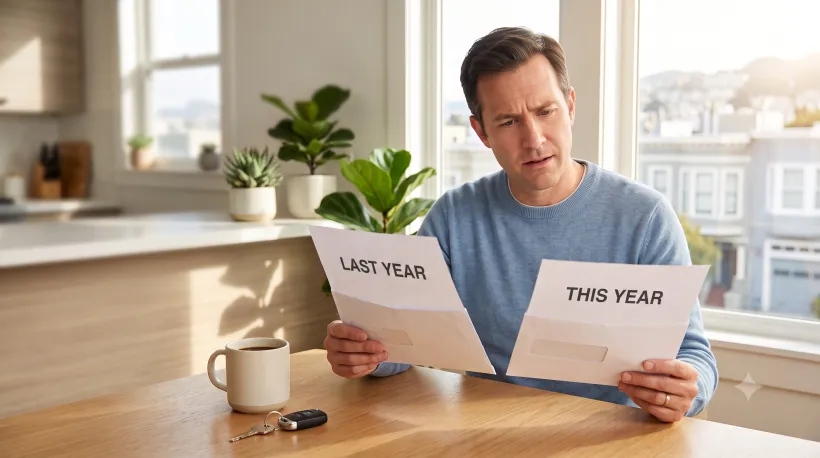
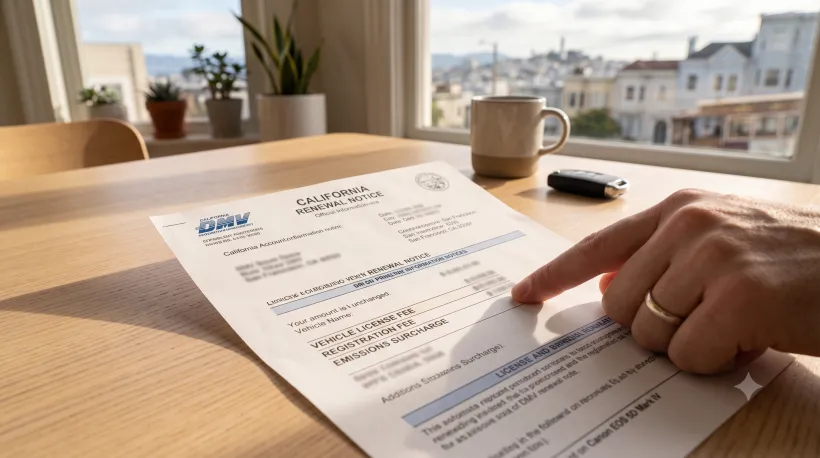
You paid your registration last year, you're paying it again this year, and nothing has changed about your car—and somehow the number on the bill is different. It went down, or up, or down on one line and up on another, and the renewal notice doesn't explain any of it.
This happens to California drivers every single year, and the confusion is understandable: California doesn't charge a flat fee for vehicle registration. It charges a formula, and several of the inputs to that formula change automatically from year to year whether you do anything or not.
Some of those changes work in your favor—the largest component of most registration bills decreases predictably as your vehicle ages. Others can push the total up regardless of how old your car is: inflation adjustments to a state infrastructure fee, county surcharges that increase independently of the state, and new fee categories that apply when you weren't expecting them.
Understanding which part of your bill moved and why makes the whole system a lot less frustrating—and occasionally reveals that you're paying more than you should be.
The Two Types of Fees on Your Bill: Fixed and Variable
Before getting into what changes and why, it helps to know that California's registration fees fall into two very different categories. Some are fixed—they're the same dollar amount regardless of your vehicle or where you live. Others are variable—they're calculated from inputs that shift every year.
The fixed fees are the base registration fee ($76) and the California Highway Patrol fee ($34)—it's the current amount in 2026.
These are flat charges that appear on virtually every standard registration bill in California, unchanged from one year to the next unless the legislature acts to adjust them.
Everything else on your bill is variable to some degree. The vehicle license fee changes as your car's assessed value depreciates. The Transportation Improvement Fee moves with inflation and can also shift when your vehicle's value crosses into a different bracket. County and district fees are set locally and can be adjusted independently by each county or air quality management district. Smog-related fees change based on your vehicle's age. And if you drive an electric vehicle, there's a road fee that didn't exist at all until recently.
The fact that your fixed fees stay the same is why your total doesn't fluctuate as wildly as it might otherwise—it has a floor. But the variable components can move in multiple directions at once, which is why the total can look surprising even on a car you've owned for years.
The Biggest Reason Your Fee Goes Down: VLF Depreciation
For most California drivers, the largest single variable on the registration bill is the vehicle license fee. The VLF is calculated at 0.65% of your vehicle's current assessed value—and that assessed value decreases on a set schedule every year you own the car.
The California DMV depreciates a vehicle's value for VLF purposes over an eleven-year schedule, beginning with the first year the vehicle is sold new or first classified for registration purposes. According to published DMV formulas, the depreciation works roughly as follows: the first year uses 100% of the purchase price, the second year uses 90%, the third year 80%, dropping by approximately 10 percentage points per year until the eleventh year, which uses around 15% of the original price. After year eleven, the VLF stabilizes at that floor—it doesn't drop further unless the vehicle changes hands, which resets the clock.
What this looks like in practice: on a vehicle originally purchased for $35,000, the VLF in year one is 0.65% × $35,000 = $227.50. In year six, when the assessed value has dropped to approximately 50% of the purchase price, the VLF is 0.65% × $17,500 = $113.75. In year eleven, at 15% of original value, it's 0.65% × $5,250 = $34.13. That's a reduction of nearly $200 on this one line item alone over the life of the vehicle—which is why long-time owners of older cars often notice their bill shrinking each year without doing anything differently.
One important rule that resets this clock: vehicle transfers. When you sell a car and the new owner registers it, the VLF calculation begins again using the new sale price as the starting value—even if the car is ten years old. This is why buying a used car in California can sometimes come with a higher registration fee than the previous owner was paying: the depreciation schedule restarts from the transaction price, not from the original manufacturer's suggested retail price.
The year model is never used to determine VLF—only the purchase price and how many registration years have elapsed since the most recent sale or classification.
The Reason Your Fee Can Go Up Even on an Older Car: TIF Inflation
The Transportation Improvement Fee was created by Senate Bill 1 in 2017 to fund road repairs and infrastructure that gas tax revenue couldn't cover. Unlike the VLF, which is a straightforward percentage of your vehicle's value, the TIF is a tiered fee—vehicles are placed into brackets based on their current assessed value, and each bracket carries a specific dollar amount.
The TIF is adjusted for inflation annually. That adjustment can push tier amounts up from one year to the next, and it can also create situations where a vehicle's fee jumps or drops not because its assessed value changed dramatically, but because the tier thresholds themselves shifted.
There's also a bracket-crossing effect worth knowing about. A vehicle whose depreciated assessed value sits near the top of one TIF bracket may drop into the lower bracket as it continues to depreciate—which would actually reduce the TIF portion of the bill in that year, sometimes significantly. The reverse is less common but can happen when inflation-adjusted tier thresholds move upward while your vehicle's assessed value stays near a boundary.
Because the TIF is inflation-adjusted and the specific tier amounts and thresholds change each year, any figures quoted here for individual brackets would be out of date by the next renewal cycle. The DMV fee calculator reflects the current-year TIF schedule and is the only reliable source for your actual TIF amount.
County Fees: The Variable You Have the Least Control Over
Your county and district fees are set by local agencies—county transportation authorities, air quality management districts, and other regional bodies—and they are not under the California DMV's control. When a county board votes to increase an air quality fee or add a new transportation surcharge, that increase appears on every registered vehicle owner's bill in that county at the next renewal cycle.
This is one of the most common reasons a driver's total goes up from one year to the next on a car that's getting older and should theoretically be getting cheaper to register. The VLF may have gone down by $20, but if the county added a $25 surcharge or increased an existing fee, the net effect is a higher bill. Counties with the highest add-ons—Los Angeles, Alameda, and San Diego—have historically carried district fees in the $40–$50 range, while rural counties often sit closer to the $25 minimum.
There's no straightforward way to look up what your specific county charges independently of the full registration calculation. The DMV fee calculator incorporates county-specific fees when you enter your vehicle details, which is why the calculator is more useful than any general estimate for predicting your actual bill.
Smog-Related Fees: The Age-Bracket Transition
California's smog requirements create a specific fee change at a predictable point in your vehicle's life. Gasoline-powered vehicles that are fewer than eight model years old pay an annual $20 smog abatement fee in lieu of undergoing a biennial smog inspection. Once the vehicle passes the eight-model-year mark, the smog abatement fee disappears from the bill—but the vehicle becomes subject to the actual biennial smog inspection requirement, which carries its own cost when the inspection is due.
For drivers who have owned a vehicle since it was new, this transition year is one of the more noticeable changes on the registration bill: the $20 smog abatement fee disappears, and in even-numbered inspection years, the registration cannot be completed without a passing smog certificate. The net financial effect varies—the abatement fee goes away, but a smog inspection at a licensed station typically costs $30–$80 depending on the station and vehicle type.
Electric vehicles are exempt from both the smog inspection requirement and the smog abatement fee at every age.
New Fee Categories: When Something Appears That Wasn't There Before
The RIF—Road Improvement Fee—is the clearest recent example of a fee that appeared on EV owners' bills without much warning. Because electric vehicles don't pay gasoline taxes that fund road maintenance, California introduced a fee on model year 2020 and newer zero-emission vehicles to compensate for that lost revenue. The fee applies at renewal, not at initial registration from a licensed dealer.
The specific amount of the RIF has been reported differently across sources—figures in the range of $100 to $121 appear in 2025–2026 references—and the fee itself can be adjusted through legislative action. Verify the current RIF amount for your model year and vehicle using the DMV fee calculator before budgeting. This is a fee category that has changed since its introduction and may change again.
For EV owners who bought their vehicle before the RIF existed or before their model year became subject to it, the first renewal where the RIF appears is often genuinely surprising. The vehicle is older, the VLF is lower than it was at purchase, and yet the total has gone up—sometimes significantly—because a new line item appeared that simply didn't exist before.
The broader lesson here is that California's fee structure is not static. New fee categories can be added by legislative action, existing fees can be adjusted, and exemptions can change. The DMV's fee calculator is updated to reflect the current-year schedule, which is why it's more reliable for planning than any published list of amounts—including this one.
What Happens to Your Bill When You Buy a Used Car
If you recently purchased a used vehicle and your registration bill looks higher than you expected—or higher than what the previous owner mentioned paying—the explanation is almost always the VLF reset.
When a vehicle is transferred, the VLF depreciation clock resets to year one using the new sale price. This means a seven-year-old car that the previous owner was registering at a steeply discounted VLF may now carry a significantly higher VLF for you, calculated from the price you paid. If you bought the car for $18,000, your year-one VLF is 0.65% × $18,000 = $117. If the previous owner had been paying VLF on the same car at 30% of a $30,000 original purchase price ($90 value × 0.65% = effectively much less), you can see how the transfer creates a meaningful jump.
This is also relevant when buying from a dealer versus a private seller. The sale price used for VLF purposes is the actual transaction price—the DMV does not allow trade-in values, rebates, or discounts to reduce the taxable amount. The value of a trade-in, rebate, or exchange of a vehicle is not deducted from the purchase price for VLF classification purposes.
How to Check What Changed on Your Specific Bill
If you want to understand exactly why your total is different from last year—not just in general terms, but for your actual vehicle—the most direct approach is to use the DMV's fee calculator twice: once with your vehicle's details as they were last year, and once with the current year. The difference will show you which line items changed and by how much.
The DMV fee calculator at dmv.ca.gov has a dedicated tool for registration renewal estimates that takes your plate number and VIN and returns the current fee breakdown by component. This shows you the VLF, TIF, county fees, and any situational fees like the smog abatement fee or RIF as separate line items, making it straightforward to identify what moved.
If completing the renewal yourself, Xtreet's online platform, as a licensed California DMV partner, retrieves the same fee details from the DMV database when you enter your vehicle information, so you see your actual total before paying—no surprises at checkout.
FAQ
- Why did my California registration fee go down this year?
The most common reason is VLF depreciation. The Vehicle License Fee is calculated at 0.65% of your vehicle's assessed value, which decreases on a set schedule every year you own the car—roughly 10 percentage points per year for the first eleven years. The older your vehicle gets, the lower the assessed value, and the lower the VLF. If your total went down, the VLF decrease likely outpaced any increases in the TIF or county fees.
- Why did my registration go up even though my car is older?
Several things can push totals up independently of vehicle age. The Transportation Improvement Fee is inflation-adjusted annually, so the amount you owe in each tier can increase even if your vehicle's assessed value didn't change much. County and district fees can also be raised by local agencies at any renewal cycle. For EV owners, the Road Improvement Fee may have appeared on the bill for the first time. Any one of these can offset or exceed the VLF reduction on an older vehicle.
- Why is my registration fee higher than my neighbor's for the same car?
Likely because you live in different counties. County and district add-ons are the biggest source of variation between otherwise identical vehicles. Los Angeles, Alameda, and San Diego counties carry higher local fees than most rural counties. Additionally, if your neighbor bought their car in a different year at a different price, the VLF base may be different even on the same model.
- Does my registration fee reset if I buy a used car?
Yes, for the VLF. When a vehicle is transferred, the depreciation clock resets and the VLF is recalculated from year one using the new sale price. If you buy a seven-year-old car for $18,000, your VLF is based on $18,000 as the starting point—not on the original manufacturer's price or on whatever the previous owner's VLF was. The TIF is also recalculated based on the new assessed value.
- What is the TIF and why does it change every year?
The Transportation Improvement Fee was created by Senate Bill 1 in 2017 to fund road and bridge maintenance. It's a tiered fee based on your vehicle's current assessed value—not a flat amount. The TIF is adjusted for inflation annually, which means the tier amounts can increase even if your vehicle's value stays in the same bracket. For the current-year TIF amounts, use the DMV fee calculator.
- Why did a new fee appear on my EV registration bill?
If you drive a zero-emission vehicle of model year 2020 or newer, you're subject to the Road Improvement Fee at renewal. This fee was introduced to compensate for lost gasoline tax revenue that would otherwise fund road maintenance. It doesn't apply to the initial registration of a new EV purchased from a licensed California dealer—only to subsequent renewals. The exact amount can change between cycles.
- Can I predict what my registration will cost next year?
Approximately, yes—with the VLF being the most predictable component. You can estimate next year's VLF by applying the depreciation schedule to your current assessed value (reducing by approximately one step). The TIF is harder to predict because it's inflation-adjusted annually. County fees can change without notice. For the most accurate estimate before your renewal notice arrives, use the DMV fee calculator with your vehicle's VIN—it reflects the current-year schedule.
- Can Xtreet show me my registration fee total before I pay?
Yes. When you enter your plate number and VIN on Xtreet's platform, it retrieves your renewal details directly from the DMV database—including the itemized fee total for the current renewal cycle. This is the same data the DMV uses, so the figure you see reflects the current-year schedule, your vehicle's specific assessed value, and your county's fees.
Conclusion
California's registration fee changes every year because it's built from moving parts. The VLF decreases as your car ages—by design, following a set depreciation schedule—while the TIF adjusts upward with inflation, county fees move independently of the state, and new fee categories can appear when legislation creates them. None of these changes are arbitrary, and most of them follow predictable patterns once you know what drives each component.
The practical takeaway: If your bill went up, check whether the TIF increased, whether your county added a surcharge, or whether a new fee appeared on your vehicle category. If it went down, the VLF depreciation is almost certainly the reason. If you want to understand exactly what changed before your next renewal notice arrives, the DMV fee calculator is the most accurate tool available. And when you're ready to complete the renewal itself, Xtreet processes it online as a licensed California DMV partner—with your itemized fee total visible before you pay and your sticker delivered by mail.