Best Time to Renew Vehicle Registration in California: The Window That Saves You Money and Stress
Quick Answer: The best time to renew your California registration is about 60 days before expiration and at least two to three weeks before the expiration date. State law lets you renew up to 75 days early, and there is no grace period if you forget. Your registration expires at midnight on its assigned date, and penalties start the next day. Renewing early in that window leaves room to fix smog, insurance, parking violations, or payment problems before they become late fees.
Most drivers treat renewal as a secondary task among a host of other matters. They wait for the last week, hope nothing is blocking the account, and find out otherwise at checkout.
The better approach is to treat it as a window with an opening, a sweet spot, and a hard stop. We cover:
- when the renewal window opens and when it closes;
- why the last week is the riskiest time to renew;
- how smog, insurance, and payment timing change your plan;
- what the January 2027 fee update means for timing;
- what to do if you are already late.
Imagine a driver whose registration expires on March 15. She sees the date on her registration card in January, opens the notice when it arrives, books a smog test the same week, and renews a month before the deadline. Nothing goes wrong, so nothing costs her extra.
The second driver puts off the renewal, figuring there is still plenty of time. She finally starts the process during the last week before expiration, only to discover that she needs a smog check and has to wait for an appointment. A delay in testing or processing could push her past the deadline and leave her with an expired registration and additional costs.
The rest of this guide shows how to build the same margin as the first driver and avoid the last-minute rush.

The Renewal Window: When It Opens and When It Closes
California gives you a long runway and a hard stop. The opening is set by law. A vehicle owner can renew no more than 75 days before the current registration expires. The DMV's procedures manual repeats the same limit.
Owners may renew or file for planned nonoperation up to 75 days before the expiration date.
The notice arrives inside that window.
The DMV must notify owners that renewal fees are due at least 60 days before the renewal date. If you signed up for paperless notices, the email arrives on the same schedule, and you can renew online right away.
The closing is not flexible.
Every registration expires at midnight on its assigned expiration date, and the renewal or a planned nonoperation certification must be filed on or before that date to avoid a late penalty. The DMV states plainly that California has no grace period.
| Point in time | What it means |
| 75 days before expiration | Earliest date state law allows renewal |
| About 60 days before | The DMV renewal notice is due (paper or email) |
| 30 to 45 days before | A comfortable zone to renew, with time to fix problems |
| 14 to 21 days before | Latest sensible date for a card payment, so a mailed sticker has time to arrive |
| Midnight on the expiration date | Last moment to renew without a late penalty |
| The next day | Penalties begin |
One more detail trips people up.
Your plate sticker shows only a month and a year, but the registration expires on a specific date printed on your registration card. Check the card, not the sticker, when you set your reminder.
Why the Last Week Is the Riskiest Time to Renew
Renewing on the final day works only when everything is clean. A renewal has several parts, and any one of them can stall the transaction. Because there is no grace period, a problem discovered on day 29 of a 30-day month can cost you a penalty tier.
Smog is the most common blocker
Gasoline vehicles older than eight model years need a passing smog certification before registration is completed, and a failed test needs time for repairs. The DMV advises owners who lack a smog certification or proof of insurance to pay their fees on or before the expiration date to avoid penalties. Paying on time protects you from the late penalty, but your registration is not complete until the missing requirement is satisfied, so the test should happen early.
Holds are the second blocker
Unpaid parking or toll violations, an insurance flag, or a court hold will stop the renewal, and clearing them takes days, not minutes.
Payment is the third
A renewal paid by electronic check with a mistyped account number fails quietly, and the DMV may mail your sticker before it learns the payment bounced. A card payment tells you immediately if something is wrong, and an early date leaves time to try again.
Delivery is the fourth
After an online renewal, the DMV typically mails the card and sticker within about two weeks. A mailed check can take six to eight weeks from start to finish, so mail is a poor choice close to the deadline.
Step-by-Step: Building a Safe Renewal Window
The steps below give you margin without extra effort. Follow them in order, and you should never be near the deadline.
Step 1: Find your exact expiration date and renewal requirements
Read it on your registration card or renewal notice, and set a calendar reminder for 60 days earlier. If you tend to ignore reminders, set a few.
Update your address if you moved so the notice and the sticker go to the right place.
Book a smog check if it is required. The certificate stays valid for 90 days, so a test taken right after the notice is still good when you renew. The station reports the result electronically to the DMV and if it fails, you'll have time to fix the situation.
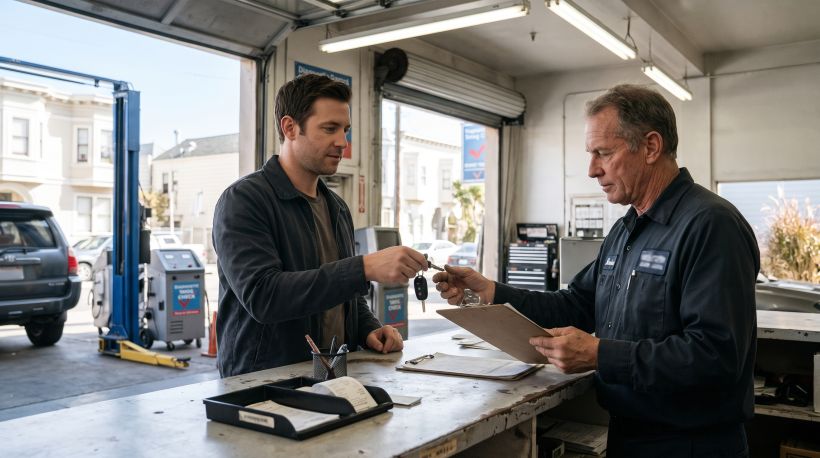
Step 2: Clear any holds
Pay parking or toll violations and confirm your insurance is on file with the DMV.
Step 3: Renew with at least two to three weeks to spare
Choose the option that's most convenient for you: submit your application through the DMV website or a DMV-authorized provider such as Xtreet.com.
Use a card for real-time confirmation. Review the total before you pay, and compare it with last year's bill.
Step 4: Confirm the result
Two days after paying, check your registration status at the DMV website with your plate number and the last five VIN characters. A mailed sticker alone does not prove that payment cleared.
Does the Time of Year or the January 2027 Fee Update Matter?
California adjusts several fees every January 1 using the Consumer Price Index. The DMV has already announced the next round.
A September 17, 2026 DMV memo lists CPI-based increases to registration, CHP, Transportation Improvement Fee, and Road Improvement Fee amounts, effective January 1, 2027.
| Fee | Current | Effective January 1, 2027 |
| Registration fee (VC Section 9250) | $73 | $76 |
| CHP fee | $34 | $35 |
| Road Improvement Fee (zero-emission, model year 2020 and newer) | $121 | $127 |
| Transportation Improvement Fee (TIF): Increases by $2 to $11 depending on vehicle value. | ||
| TIF, vehicle value $0 to $4,999 | $33 | $35 |
| TIF, $5,000 to $24,999 | $66 | $69 |
| TIF, $25,000 to $34,999 | $132 | $138 |
| TIF, $35,000 to $59,999 | $198 | $208 |
| TIF, $60,000 or more | $231 | $242 |
The memo does not say whether a renewal paid in December for a January expiration is charged the old or the new amounts. It says only that DMV programming will generate the appropriate fees.
Plan around the deadline and the margin, and use the DMV fee calculator or an estimate before you pay.
What If You Are Already Past the Deadline?
If your registration has already expired, speed matters more than anything else. When payment arrives after the expiration date, penalties are added on top of the renewal amount.
The schedule steps up over time, so each tier you avoid saves money.
| How late | Penalty on vehicle license fee | Registration late fee | CHP late fee |
| 1 to 10 days | 10% | $10 | $10 |
| 11 to 30 days | 20% | $15 | $15 |
| 31 days to 1 year | 60% | $30 | $30 |
| More than 1 year to 2 years | 80% | $50 | $50 |
| More than 2 years | 160% | $100 | $100 |
If the vehicle truly will not be driven, towed, stored, or parked on public roads, you may file for planned nonoperation instead. The DMV accepts a PNO filing up to 90 days after expiration, with penalties, as long as the vehicle has not been on public roads. After that window, full fees and penalties apply.
After six months of expired registration, a vehicle can also be towed.
Common Mistakes
- Waiting for the final week. A single hold, failed payment, or smog failure can push you into a penalty tier.
- Reading the sticker as the deadline. The sticker shows a month and year. The registration expires at midnight on the date printed on your card.
- Mailing a check close to the deadline. Mail is the slowest channel, and a stop payment on a mailed check is treated as a dishonored payment.
- Paying by electronic check at the last minute. A mistyped account number fails quietly, and you may not find out until late penalties are accruing.
- Treating the sticker as proof that you are renewed. The DMV can mail a sticker before payment fully clears. Check your status online.
- Planning around a fee change. The January 2027 memo does not promise a saving for early renewals, so the safest plan is simply to renew in the sweet spot.
How Xtreet.com Helps You Renew in the Best Window
Xtreet.com is a DMV-authorized service provider that lets you renew online without visiting a DMV office.
- You enter your vehicle details on the Xtreet.com registration renewal page.
- Xtreet.com checks the available vehicle information and shows an estimate before checkout.
- You review the breakdown and pay.
- Xtreet.com submits the renewal to the DMV, and you receive a digital confirmation.
- The new registration documents are mailed to you.
Xtreet.com's standard service fee for registration renewal is $49.95, with a 20% discount on service fees for customers experiencing financial hardship.
DMV fees, payment-processing charges where applicable, and document shipping are separate, and the itemized breakdown on the Xtreet.com fees page is available before you pay. The DMV's own online portal remains the lowest-cost route for a clean renewal, so Xtreet.com is a good fit when you want a guided process and an estimate in front of you.

Frequently Asked Questions
How early can I renew my registration in California?
State law lets you renew up to 75 days before your registration expires. The DMV must send your notice at least 60 days before expiration, so most drivers start when the notice arrives.
What is the last day to renew without a penalty?
Your registration expires at midnight on the assigned expiration date, and you must renew or file for planned nonoperation on or before that date. California has no grace period, and penalties begin the next day.
Is there a grace period for late registration in California?
No. The DMV states that California has no grace period, and penalties increase with each tier of delay.
Should I do the smog check before I pay?
Yes, ideally, if you need it. The certificate is valid for 90 days, so a test taken after your notice arrives is still good when you renew. If you cannot finish the smog check in time, the DMV advises paying on or before the expiration date to avoid penalties, but the registration will not be complete until the requirement is met.
How long does it take to get my sticker?
After a completed online renewal, the DMV typically mails the card and sticker within about two weeks. If eight weeks pass without anything arriving, call 1-800-777-0133. A mailed check takes much longer.
Will fees go up in January 2027?
Yes. A DMV memo dated September 17, 2026 lists CPI-based increases effective January 1, 2027, including the registration fee, the CHP fee, the Transportation Improvement Fee tiers, and the Road Improvement Fee. The memo does not say whether an early renewal for a January expiration receives the old or new amounts, so check the DMV fee calculator before you pay.
What if I never got a renewal notice?
You are still responsible for renewing on time. Your expiration date is printed on your registration card, and under Vehicle Code Section 1661 a missing notice does not excuse a late renewal.
What if my car will not be driven this year?
You can file for planned nonoperation on or before the expiration date. The DMV accepts the filing up to 90 days after expiration, with penalties, as long as the vehicle has not been on public roads.
Can I renew through Xtreet.com?
Yes. Xtreet.com processes registration renewal online as a DMV-authorized provider. You see an estimate before checkout, and the DMV-generated invoice sets the final state-fee amount.
Conclusion
The best time to renew is earlier than most people expect and later than the law allows. The window opens up to 75 days before expiration, your notice arrives about 60 days out, and the practical sweet spot is a month or so before the deadline, when smog, insurance, holds, and payment problems can still be fixed without a penalty.
The hard stop is midnight on the expiration date, and nothing softens it.
A few habits do most of the work.
Set a reminder for 60 days before expiration, read the date on your registration card, book smog the week your notice arrives, pay by card, and check your status two days later.
Xtreet.com lets you check your estimate early and renew online as a DMV-authorized provider, with the state-fee amount confirmed by the DMV and your documents mailed to you.
Start your registration renewal on Xtreet.com while you still have time to spare.